

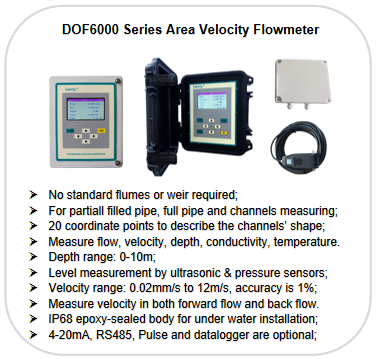
Partially filled pipes, where fluids do not fully occupy the pipe cross-section and the liquid surface is exposed to the atmosphere, are common in municipal drainage, industrial wastewater discharge, and agricultural irrigation systems. Unlike full-pipe flow, the flow state in partially filled pipes is unstable and easily affected by pipe slope, sediment accumulation, and flow fluctuations, posing significant challenges to accurate flow measurement. Open channel partially filled pipe flow meters, which integrate open channel measurement principles with pipeline adaptation designs, have become the core solution for this scenario. This article explores their application value, typical application fields, technical adaptation characteristics, and practical advantages in partially filled pipes.
The core advantage of open channel partially filled pipe flow meters in non-full pipe applications lies in their ability to adapt to the dynamic flow state of partially filled pipes. Traditional full-pipe flow meters (such as electromagnetic or ultrasonic flow meters for closed pipes) often fail to work properly under non-full pipe conditions, as their measurement principles rely on the fluid filling the pipe to form a stable measurement environment. In contrast, open channel partially filled pipe flow meters calculate flow rate based on the relationship between liquid level (head) and flow velocity in the pipe, which is consistent with the open channel flow characteristics of partially filled pipes. They can accurately capture changes in flow velocity and cross-sectional area caused by liquid level fluctuations, ensuring measurement accuracy even in low-flow or variable-flow scenarios.
Municipal drainage systems are one of the most important application fields of open channel partially filled pipe flow meters. Urban stormwater and domestic sewage pipelines often operate in a partially filled state—sewage flow is low during dry seasons, while stormwater can cause short-term high flow, but both rarely fill the pipe completely. Installing these flow meters in key sections of the drainage network allows for real-time monitoring of flow changes, helping municipal departments grasp the operational status of the drainage system, predict urban waterlogging risks, and optimize the layout of drainage facilities. For example, in old urban areas with outdated pipeline networks, the meters can monitor sediment accumulation by tracking changes in flow velocity under the same liquid level, providing data support for pipeline dredging work.
Industrial wastewater discharge is another critical application scenario. Many industrial processes (such as chemical, food and beverage, and mining) generate wastewater with uneven discharge volumes, leading to non-full pipe operation in discharge pipelines. Environmental protection regulations require enterprises to accurately measure and report wastewater discharge volumes, and open channel partially filled pipe flow meters can meet this demand. They are resistant to corrosion and clogging, adapting to the characteristics of industrial wastewater containing suspended solids or chemical components. For instance, in mining areas, the meters can stably measure the flow of ore-washing wastewater in partially filled pipelines, ensuring enterprises comply with discharge standards while providing data for water resource recycling.
In agricultural irrigation systems, open channel partially filled pipe flow meters play a key role in water-saving management. Irrigation water is usually transported through pipelines with varying slopes, and the flow rate is adjusted according to crop water needs, resulting in frequent non-full pipe operation. The meters can accurately measure the actual irrigation water volume, helping farmers and water management departments optimize irrigation schedules, reduce water waste, and improve water use efficiency. In addition, in large-scale agricultural water conservancy projects, they are used to monitor water distribution in branch pipelines, ensuring fair and reasonable water allocation among different farmlands.
The practical application of open channel partially filled pipe flow meters in non-full pipes also benefits from their flexible installation and low maintenance characteristics. They can be installed without changing the original pipeline structure—either externally clamped or inserted, avoiding pipeline excavation and downtime. For pipelines with serious sediment accumulation, some models are equipped with self-cleaning sensors to prevent fouling from affecting measurement accuracy. Moreover, most of these meters support remote data transmission, enabling centralized monitoring and management of multiple measurement points, which is particularly suitable for large-scale pipeline networks such as municipal drainage and agricultural irrigation.
In conclusion, open channel partially filled pipe flow meters address the measurement challenges of non-full pipe scenarios that traditional flow meters cannot solve. Their wide application in municipal drainage, industrial wastewater discharge, and agricultural irrigation not only ensures accurate flow measurement but also provides reliable data support for water resource management, environmental protection, and water-saving operations. With the continuous advancement of sensor technology and intelligent monitoring systems, these flow meters will be more adaptable to complex non-full pipe environments, playing an increasingly important role in promoting efficient and sustainable water resource utilization.
Post time: Dec-30-2025