

In industries where accurate flow measurement is critical yet intrusive installation is impractical or risky, clamp-on ultrasonic flow meters have emerged as a game-changing solution. These devices, which attach externally to pipes without penetrating the fluid stream, leverage ultrasonic technology to measure flow rates with remarkable precision—revolutionizing how sectors like water management, HVAC, and chemical processing monitor and optimize fluid systems.
How Clamp-On Ultrasonic Flow Meters Work
At their core, clamp-on ultrasonic meters operate on the principle of transit-time measurement. Two transducers are mounted on the outer surface of a pipe, typically opposite each other or at a specific angle. One transducer emits ultrasonic waves through the pipe wall and into the flowing fluid, while the second receives the signal.
- Upstream vs. Downstream Signals: The ultrasonic wave traveling with the fluid flow (downstream) reaches the receiver faster than the wave traveling against the flow (upstream). This time difference, known as the transit-time differential, is directly proportional to the fluid’s velocity.
- Calculating Flow Rate: Using the pipe’s diameter and the fluid’s velocity (derived from the transit-time differential), the meter calculates volumetric flow rate. Advanced models also account for factors like pipe material, wall thickness, and fluid properties (e.g., viscosity) to refine accuracy.
This non-invasive design eliminates the need for cutting pipes, welding, or shutting down systems during installation—minimizing downtime and avoiding contamination risks, especially critical in industries handling potable water, food-grade fluids, or hazardous chemicals.
Key Advantages Over Invasive Meters
Clamp-on ultrasonic flow meters offer distinct benefits that set them apart from traditional invasive devices (e.g., turbine, electromagnetic, or differential pressure meters):
- Non-Intrusive Installation: By attaching externally, they avoid contact with the fluid, making them ideal for sterile environments (pharmaceuticals, food processing) or corrosive/abrasive fluids (sewage, slurries) that would damage internal sensors.
- Cost-Effective and Versatile: No pipe modification means lower installation costs and compatibility with a wide range of pipe materials (metal, plastic, concrete) and sizes (from 0.5 inches to over 100 inches in diameter).
- Minimal Maintenance: Without moving parts or components exposed to the fluid, there’s no wear from friction, clogging, or chemical corrosion—reducing upkeep and extending service life.
- Flexibility in Applications: They can be easily repositioned to measure flow in different pipes, making them useful for temporary monitoring, troubleshooting, or validating readings from existing meters.
Applications Across Industries
The versatility of clamp-on ultrasonic meters makes them indispensable in diverse sectors:
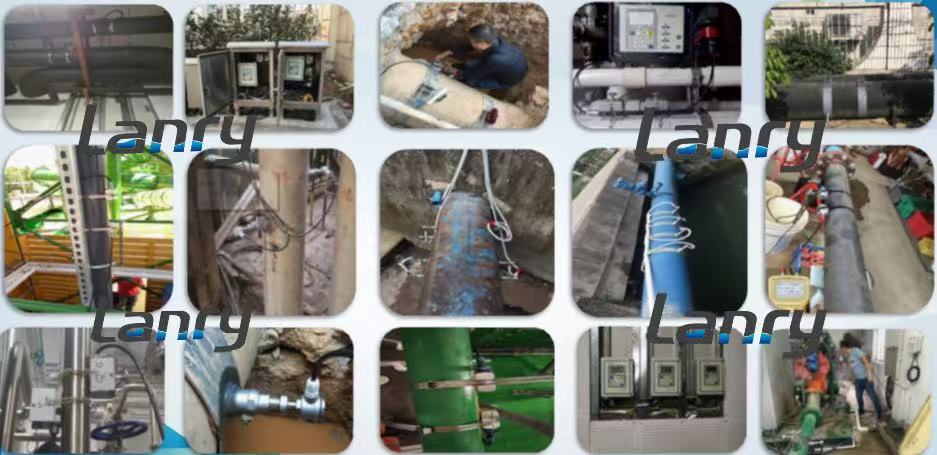
- Water and Wastewater Management: Used to monitor flow in distribution networks, detect leaks, or verify billing meters in municipal systems. Their non-invasive nature avoids disrupting water supply during installation.
- HVAC and Building Services: Measure chilled water, hot water, or glycol flow in heating and cooling systems to optimize energy use and identify inefficiencies.
- Industrial Processing: Monitor flow in chemical lines, cooling circuits, or fuel pipelines without risking contamination or system shutdowns.
- Oil and Gas: Deployed in pipelines to measure crude oil, refined products, or natural gas, even in remote or hazardous locations where invasive meters are impractical.
Considerations for Optimal Performance
While highly reliable, clamp-on meters require careful setup to ensure accuracy:
- Pipe Condition: The pipe surface must be clean and free of rust, paint, or insulation to ensure proper transducer contact.
- Fluid Properties: Turbulence, air bubbles, or suspended solids can affect signal transmission. Some models include advanced algorithms to mitigate these issues.
- Installation Expertise: Proper transducer placement (distance from elbows, valves, or pumps) and alignment are critical to avoid flow disturbances that skew readings.
Manufacturers often provide software tools to guide installation, including pipe material databases and calibration wizards, simplifying setup for users.
The Future of Clamp-On Technology
Advancements in digital signal processing and wireless connectivity are enhancing clamp-on meters’ capabilities. Modern models offer real-time data transmission via IoT protocols, enabling remote monitoring and integration with SCADA systems. Some include battery-powered designs for use in off-grid locations, further expanding their utility.
As industries prioritize efficiency, safety, and minimal disruption, clamp-on ultrasonic flow meters stand out as a smart, sustainable choice. They prove that precision in flow measurement doesn’t require intrusion—offering a seamless blend of accuracy, versatility, and cost-effectiveness for the challenges of modern fluid management.
In essence, clamp-on ultrasonic flow meters are more than tools—they are enablers of smarter, more adaptive industrial processes, where measurement excellence meets operational practicality.
Post time: Aug-14-2025