

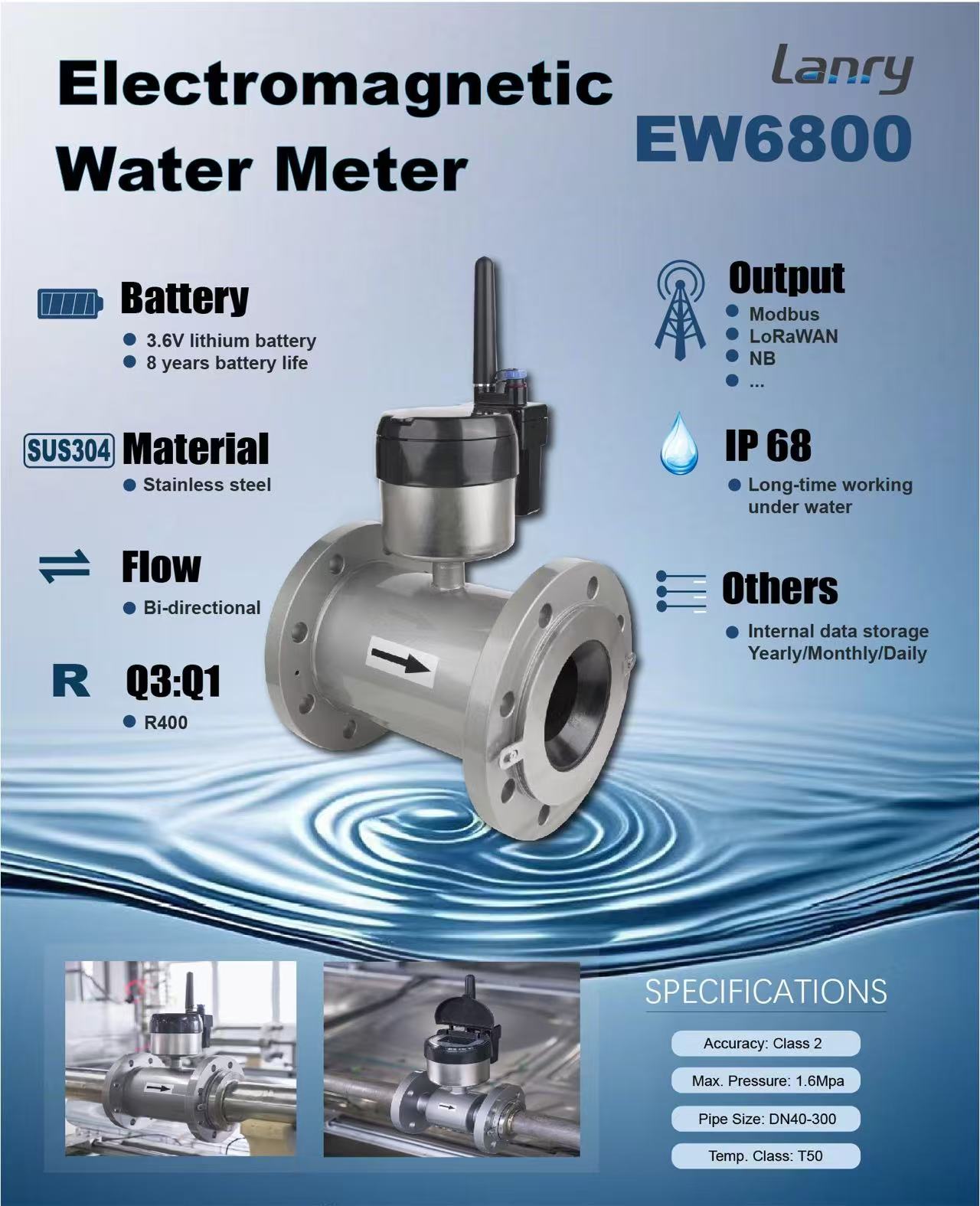

In the modern water metering landscape, electromagnetic water meters and ultrasonic water meters stand out as two prevalent and advanced technologies. Each type has its own unique characteristics, which are derived from their distinct operating principles. Understanding these differences is crucial for water utilities, industrial users, and other stakeholders to make informed decisions when choosing the most suitable water metering solution for their specific applications.
1. Operating Principles
Electromagnetic water meters operate based on Faraday's law of electromagnetic induction. When a conductive fluid, such as water, flows through a magnetic field created within the meter, an electromotive force (EMF) is induced. This induced EMF is proportional to the velocity of the fluid flow. The meter measures this EMF using electrodes placed on the opposite sides of the flow tube. By measuring the strength of the induced voltage, the velocity of the water can be determined. Since the cross - sectional area of the flow tube is known, the volumetric flow rate of water can be calculated using the formula
Q=v×A, where Qis the flow rate, v is the velocity, and A is the cross - sectional area.
1.2 Ultrasonic Water Meters
Ultrasonic water meters, on the other hand, utilize the time - of - flight principle of ultrasonic waves in a fluid. They measure the time difference between the upstream and downstream propagation of ultrasonic signals through the flowing water. When an ultrasonic wave is transmitted into the water, its propagation speed is affected by the velocity of the water flow. If the wave is sent in the direction of the flow (downstream), it will travel faster, and if sent against the flow (upstream), it will travel slower. By precisely measuring this time difference, the velocity of the water can be calculated. Similar to electromagnetic water meters, once the velocity is known, the volumetric flow rate can be determined by multiplying the velocity by the cross - sectional area of the pipe or channel where the water is flowing.
2. Performance Characteristics
2.1 Accuracy
2.1.1 Electromagnetic Water Meters
Electromagnetic water meters are renowned for their high accuracy, especially in the medium to high - flow rate ranges. They can achieve an accuracy level of up to 0.5% or even better in ideal conditions. This high accuracy is due to the stable and well - understood electromagnetic induction principle. However, factors such as changes in the magnetic field strength (which could be affected by external magnetic sources), electrode fouling, or improper installation can impact their accuracy. For example, if the electrodes become coated with deposits over time, the measured EMF may be distorted, leading to inaccurate flow rate readings.
2.1.2 Ultrasonic Water Meters
Ultrasonic water meters also offer good accuracy, typically in the range of 1% to 2% for general applications. Their accuracy can be affected by factors such as the presence of air bubbles, suspended solids, or changes in the acoustic properties of the water. Air bubbles, for instance, can scatter the ultrasonic waves, causing incorrect time - of - flight measurements. In applications with clean water and stable flow conditions, ultrasonic water meters can provide reliable and accurate readings. In some advanced models, techniques such as multi - path ultrasonic sensing are used to improve accuracy by averaging the measurements from multiple ultrasonic paths within the water flow.
2.2 Flow Range
2.2.1 Electromagnetic Water Meters
Electromagnetic water meters generally have a wide flow range, with a typical rangeability (the ratio of the maximum to the minimum measurable flow rate) of 100:1 or more. They are well - suited for measuring both high - flow industrial applications, such as in large water treatment plants or industrial cooling systems, and medium - flow residential and commercial applications. However, their performance at very low flow rates can be somewhat limited. At extremely low velocities, the induced EMF may be too weak to be accurately measured, leading to potential inaccuracies in the lower end of the flow range.
2.2.2 Ultrasonic Water Meters
Ultrasonic water meters are known for their excellent low - flow measurement capabilities. They can often detect flow rates as low as 0.01 m/s or even lower, making them highly suitable for applications where small leaks or low - flow consumption need to be accurately measured, such as in residential water metering for leak detection. Their rangeability can be quite high, with some models achieving ratios of 400:1 or more. This wide flow range allows them to handle a broad spectrum of applications, from small - scale household water usage to large - scale industrial and municipal water distribution systems.
2.3 Pressure Loss
Electromagnetic water meters typically have a relatively low pressure loss. The design of the flow tube in electromagnetic meters is often straight and unobstructed, which minimizes the resistance to the water flow. This is beneficial in applications where maintaining a high - pressure water supply is crucial, such as in large - scale industrial processes or in water distribution networks over long distances. The low - pressure loss helps to reduce the energy consumption of pumps and other water - moving equipment, as less energy is required to overcome the resistance in the meter.
2.3.2 Ultrasonic Water Meters
Ultrasonic water meters also generally exhibit a low - pressure loss. The measurement process in ultrasonic meters does not involve any physical obstruction within the flow path, as the ultrasonic sensors are usually mounted on the outside of the pipe or flow channel. This non - intrusive measurement method ensures that the water flow is not significantly impeded, resulting in a minimal pressure drop across the meter. Similar to electromagnetic meters, this characteristic makes ultrasonic water meters suitable for applications where pressure conservation is important.
2.4 Response Time
2.4.1 Electromagnetic Water Meters
Electromagnetic water meters have a relatively fast response time. Once there is a change in the water flow velocity, the induced EMF changes almost instantaneously, and the meter can quickly detect and register this change. This fast response time makes them suitable for applications where real - time monitoring of flow rate changes is required, such as in industrial processes where sudden changes in water demand need to be promptly detected and managed.
2.4.2 Ultrasonic Water Meters
Ultrasonic water meters also offer a rapid response time. The measurement of the time - of - flight of ultrasonic waves is a fast - paced process, and any changes in the water flow velocity are quickly reflected in the measured time difference. This allows for quick detection of flow rate variations, which is useful in applications such as water distribution network monitoring, where sudden changes in water usage patterns can be promptly identified.
3. Environmental and Installation Considerations
3.1 Installation Requirements
3.1.1 Electromagnetic Water Meters
Electromagnetic water meters require a certain amount of straight - pipe length upstream and downstream of the meter installation location. This is to ensure that the water flow is fully developed and uniform before it enters the meter, which is essential for accurate measurement. Typically, an upstream straight - pipe length of 5 to 10 times the pipe diameter and a downstream straight - pipe length of 2 to 5 times the pipe diameter are recommended. Additionally, electromagnetic water meters need to be installed in a location where there is no strong external magnetic interference, as this can disrupt the magnetic field within the meter and affect the accuracy of the measurements.
3.1.2 Ultrasonic Water Meters
Ultrasonic water meters are more flexible in terms of installation requirements. They generally require less straight - pipe length compared to electromagnetic meters. In some cases, an upstream straight - pipe length of 3 times the pipe diameter or even less may be sufficient. This makes them easier to install in existing piping systems where space for straight - pipe runs may be limited. However, ultrasonic water meters need to be installed in a location where the pipe wall is smooth and free from significant corrosion or scale build - up, as these can affect the transmission and reception of the ultrasonic waves.
3.2 Environmental Sensitivities
3.2.1 Electromagnetic Water Meters
Electromagnetic water meters are sensitive to the electrical conductivity of the water. They are designed to measure the flow of conductive fluids, and if the water has a very low electrical conductivity (such as in the case of highly purified water), the induced EMF may be too weak to be accurately measured. Additionally, as mentioned earlier, external magnetic fields can interfere with the operation of electromagnetic water meters. In industrial environments with large electrical motors, transformers, or other sources of strong magnetic fields, special shielding or proper positioning of the meter may be required to ensure accurate measurement.
3.2.2 Ultrasonic Water Meters
Ultrasonic water meters are sensitive to the presence of air bubbles, suspended solids, and changes in the acoustic properties of the water. Air bubbles can scatter the ultrasonic waves, leading to inaccurate time - of - flight measurements. Suspended solids, especially if they are large or in high concentrations, can also affect the propagation of the ultrasonic waves. Moreover, changes in the temperature, salinity, or viscosity of the water can alter its acoustic properties, which may require calibration adjustments in some cases to maintain accurate measurement.
4. Cost Considerations
4.1 Initial Cost
Electromagnetic water meters generally have a relatively high initial cost. This is due to the complex manufacturing process involved in creating the magnetic field - generating components, the precision - made electrodes, and the sophisticated electronics required for measuring the induced EMF. The materials used in their construction, especially those for the magnetic circuit and the flow tube lining (to ensure electrical insulation), also contribute to the higher cost.
4.1.2 Ultrasonic Water Meters
Ultrasonic water meters also tend to have a relatively high initial cost, although it can sometimes be slightly lower than that of electromagnetic meters, depending on the specific model and manufacturer. The cost is mainly driven by the high - quality ultrasonic transducers, the advanced signal - processing electronics, and the need for precise calibration during manufacturing. However, as the technology matures and economies of scale come into play, the cost of ultrasonic water meters has been gradually decreasing.
4.2 Maintenance Cost
4.2.1 Electromagnetic Water Meters
The maintenance cost of electromagnetic water meters is relatively moderate. The main maintenance tasks involve periodic inspection and cleaning of the electrodes to prevent fouling, which can affect the accuracy of the measurements. In some cases, if the magnetic field - generating components show signs of wear or if there are issues with the electronics, more in - depth maintenance or component replacement may be required. However, since there are no moving parts in the measurement section, the overall maintenance requirements are not overly burdensome.
4.2.2 Ultrasonic Water Meters
Ultrasonic water meters typically have a low maintenance cost. Since there are no moving parts and the ultrasonic transducers are generally durable, the main maintenance task is to periodically check for any signs of damage to the transducers or the signal - processing electronics. In applications where the water contains a high amount of suspended solids or where there is a risk of transducer fouling, occasional cleaning of the transducer surfaces may be necessary. But overall, compared to some other types of water meters, ultrasonic water meters require less frequent and less costly maintenance.
5. Applications
5.1 Electromagnetic Water Meters
Electromagnetic water meters are widely used in industrial applications where accurate measurement of high - flow rates of conductive fluids is crucial. This includes industries such as chemical manufacturing, power generation (for cooling water measurement), and food and beverage production. In the water and wastewater treatment sectors, electromagnetic water meters are used to measure the flow of raw water, treated water, and wastewater. They are also commonly used in large - scale commercial buildings and apartment complexes for accurate water consumption billing.
Ultrasonic water meters find extensive applications in residential water metering, especially where the focus is on accurate measurement of low - flow rates and leak detection. They are also used in agricultural irrigation systems, where the water may contain impurities such as sand and silt, and the non - intrusive measurement method of ultrasonic meters helps to avoid issues related to clogging or damage from these impurities. In addition, ultrasonic water meters are suitable for use in water distribution networks for monitoring the flow at various points, including in areas with complex piping layouts where the flexible installation requirements of ultrasonic meters are an advantage.
In conclusion, both electromagnetic and ultrasonic water meters offer unique advantages and have their own areas of application. The choice between the two depends on various factors such as the specific requirements of the application, the characteristics of the water being measured, the installation environment, and the cost - benefit considerations. By carefully evaluating these differences, users can select the most appropriate water metering technology to meet their needs for accurate, reliable, and cost - effective water measurement.
Post time: Jun-05-2025