

In industrial fluid measurement, particle-laden fluids—such as wastewater, mining slurries, or crude oil with sediment—pose unique challenges. Traditional flowmeters, like turbine or positive displacement models, often struggle with these fluids: internal components can clog, wear down, or get contaminated, leading to frequent downtime and inaccurate readings. Doppler flowmeters, however, solve this problem by leveraging the Doppler effect for non-invasive, reliable measurement, making them indispensable in sectors where dirty or heterogeneous fluids are common.
At the heart of a Doppler flowmeter’s functionality is the Doppler effect, a physical phenomenon where the frequency of a wave changes as the source and observer move relative to each other. For flow measurement, the meter uses two key components: a transducer (mounted externally on the pipe) and a signal processor. The transducer emits high-frequency ultrasonic waves (typically 0.5 MHz to 5 MHz) into the pipe wall; these waves pass through the wall and into the flowing fluid. When the waves encounter suspended particles, bubbles, or turbulence in the fluid, they reflect back to the transducer.
The critical insight here is that the moving particles alter the frequency of the reflected waves. Particles traveling in the direction of the fluid flow (toward the transducer) compress the reflected wave, increasing its frequency. Conversely, particles moving away from the transducer stretch the wave, decreasing its frequency. The signal processor calculates the frequency shift between the emitted and reflected waves, then uses this data—paired with preprogrammed parameters like pipe diameter and fluid properties—to compute the fluid’s velocity and, ultimately, its flow rate. This entire process happens without the meter touching the fluid or disrupting its flow, eliminating the risk of clogging or component damage.
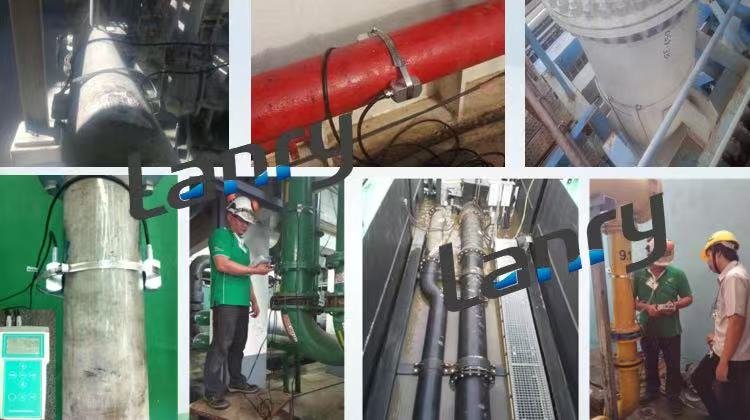
The non-invasive design of Doppler flowmeters is one of their most impactful advantages, especially for particle-laden fluids. Unlike inline flowmeters that require cutting the pipe and inserting components into the fluid stream, Doppler models use clamp-on transducers that attach directly to the pipe’s exterior. Installation takes hours (not days) and requires no process shutdowns—a critical benefit for industries like wastewater treatment, where halting flow can lead to system backups or regulatory violations. Additionally, since there are no internal parts, there’s no risk of particles getting stuck in valves or sensors, reducing maintenance costs and extending the meter’s lifespan. For example, in mining operations, where slurries contain abrasive minerals like coal or iron ore, Doppler flowmeters avoid the wear and tear that would quickly disable a turbine meter.
Precision is another standout feature of modern Doppler flowmeters, even with challenging fluids. Early models struggled with accuracy in low-concentration particle streams, but advancements in signal processing—such as digital filtering and adaptive wave tuning—have addressed this limitation. Today’s Doppler meters can maintain accuracy within ±1% to ±3% of the reading for fluids with particle concentrations as low as 10 parts per million (ppm), making them suitable for applications like chemical processing, where even small particles (e.g., catalyst fines) need to be accounted for. They also excel at measuring variable flow rates: unlike some traditional meters that lose accuracy at low velocities, Doppler models can detect flow as slow as 0.1 meters per second (m/s), a key requirement for industries like food processing, where viscous slurries (e.g., tomato paste or chocolate) often flow at low speeds.
Real-world applications highlight the versatility of Doppler flowmeters. In municipal wastewater treatment, they monitor the flow of raw sewage—filled with debris and organic particles—through pipelines, ensuring treatment plants operate at optimal capacity. In the oil and gas industry, they measure the flow of crude oil containing sand or water, helping operators track production volumes without risking damage to expensive equipment. Even in agricultural settings, they’re used to monitor the flow of fertilizer slurries, ensuring precise application to crops.
Of course, Doppler flowmeters are not a one-size-fits-all solution. They require a minimum concentration of particles (usually 10 ppm or more) to generate a usable signal; for clean fluids like drinking water or ultra-pure chemicals, transit-time ultrasonic flowmeters are a better choice. Additionally, pipe material and thickness can affect signal transmission—metallic pipes (e.g., steel) are ideal, while thick plastic pipes may require adjustments to transducer placement. But for particle-laden fluids, their non-invasive design and precision make them unmatched.
In conclusion, Doppler flowmeters have revolutionized the measurement of particle-laden fluids by turning a challenge—dirty, heterogeneous streams—into a strength. By harnessing the Doppler effect, they deliver accurate, reliable data without disrupting processes or risking component damage. As industries continue to handle complex fluids, the role of Doppler flowmeters in ensuring efficiency, compliance, and cost savings will only grow, solidifying their place as a critical tool in modern fluid management.
Post time: Sep-25-2025