

In industries like municipal wastewater treatment, mining, and chemical processing, measuring the flow of complex fluids—whether sewage laced with debris or abrasive mineral slurries—demands tools tailored to these challenging conditions. Among ultrasonic flowmeters, two dominant technologies stand out: Doppler and transit-time models. While both rely on sound waves for measurement, their core principles, strengths, and limitations differ sharply, making (selection) critical for reliable performance in wastewater and slurry applications. Understanding these differences ensures operators avoid costly mismatches, minimize downtime, and maintain accurate data for compliance and efficiency.
Core Working Principles: The Foundation of Difference
The fundamental distinction between Doppler and transit-time flowmeters lies in how they interact with the fluid being measured—especially regarding suspended particles or bubbles, which are ubiquitous in wastewater and slurries.
Doppler flowmeters leverage the Doppler effect, a phenomenon where sound wave frequency shifts when it reflects off moving objects. Here’s how it works: A clamp-on transducer mounted on the pipe exterior emits high-frequency ultrasonic waves (0.5–5 MHz) through the pipe wall into the fluid. These waves bounce off suspended particles, bubbles, or turbulence in the stream; the moving particles alter the frequency of the reflected waves (compressing waves if particles move toward the transducer, stretching them if moving away). The meter’s signal processor calculates this frequency shift, then uses pipe diameter and fluid properties to derive flow rate. Crucially, Doppler models require particles or bubbles to function—they cannot measure clean, particle-free fluids.
Transit-time flowmeters, by contrast, measure the time it takes for ultrasonic waves to travel through the fluid itself, not reflected off particles. They use two transducers (one upstream, one downstream) mounted on the pipe. A signal travels from the upstream transducer to the downstream one, riding with the fluid flow (reducing travel time), and another signal travels from downstream to upstream, working against the flow (increasing travel time). The meter calculates the time difference between these two signals; this difference is directly proportional to fluid velocity, which is then converted to flow rate. Unlike Doppler models, transit-time meters rely on the fluid to transmit sound waves—they perform best with clean, homogeneous fluids and struggle with high particle concentrations that scatter or absorb signals.
Fluid Compatibility: The Make-or-Break Factor for Wastewater & Slurries
For wastewater and slurry applications, fluid composition is the single most important factor in choosing between the two technologies.
Doppler flowmeters excel with “dirty” fluids—exactly the type found in wastewater and slurry systems. Municipal wastewater, for example, contains organic debris, grit, and air bubbles; mining slurries carry abrasive particles like coal, limestone, or metal ores; and industrial slurries (e.g., in food processing or chemical manufacturing) may include solids like catalyst fines or pulp. These particles act as “reflectors” for the Doppler meter’s ultrasonic waves, ensuring a strong, usable signal. Even highly viscous slurries (e.g., cement paste or fertilizer mixtures) pose little issue, as the meter’s non-invasive design avoids contact with the fluid—eliminating clogging or wear from abrasive solids.
Transit-time flowmeters, however, struggle with particle-laden fluids. Suspended solids scatter ultrasonic waves, weakening or distorting the signal between the two transducers. In wastewater with high debris content, this can lead to erratic readings or complete signal loss. For slurries with solid concentrations above 1–2% (by volume), transit-time meters often fail to maintain accuracy, as particles block the sound path. They are better suited for “clean” wastewater streams—such as treated effluent with minimal solids—or processes where fluids are filtered before measurement. In raw wastewater or heavy slurry applications, transit-time models risk frequent calibration or replacement due to signal interference.
Accuracy, Installation, and Maintenance: Practical Trade-Offs
Beyond fluid compatibility, practical considerations like accuracy, installation ease, and maintenance needs further separate the two technologies in wastewater and slurry use cases.
Accuracy
Doppler flowmeters typically offer accuracy ranges of ±1–3% of the reading for particle-laden fluids—sufficient for most wastewater and slurry applications, where exact custody transfer (e.g., billing for fuel) is less common than process monitoring. Their precision holds steady even with variable particle concentrations (as long as the minimum threshold of ~10 ppm is met) and low flow rates (down to 0.1 m/s), making them ideal for monitoring slow-moving slurries in mining pipelines or low-flow wastewater channels.
Transit-time flowmeters deliver higher accuracy (±0.5–1% of the reading) but only in clean fluids. In wastewater or slurries, their accuracy degrades rapidly with increasing particle content. For example, in raw sewage with 5% solids, a transit-time meter’s error margin could jump to ±5% or more—unacceptable for compliance-driven processes like wastewater discharge monitoring.
Installation
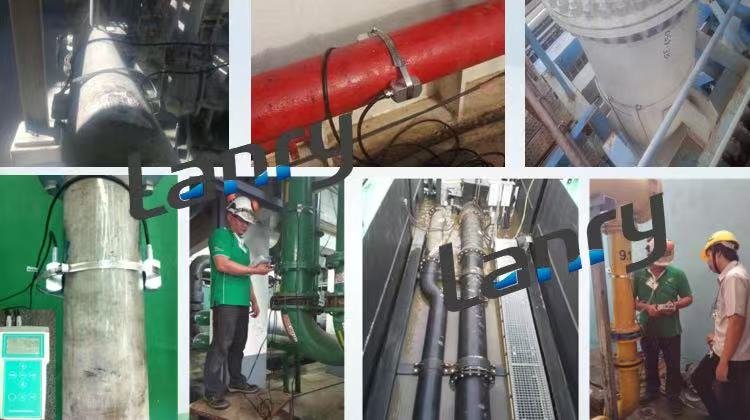
Both technologies use clamp-on designs (non-invasive), which is a major advantage for wastewater and slurry systems—no pipe cutting, welding, or shutdowns are needed, reducing installation time from days (for inline meters) to hours. However, Doppler flowmeters have fewer installation constraints: they work with most pipe materials (steel, PVC, concrete) and thicknesses, as their signal only needs to reach and reflect off particles. They also tolerate inconsistent pipe conditions (e.g., minor corrosion or scaling), which are common in wastewater pipelines.
Transit-time flowmeters require more precise installation: pipe walls must be smooth and uniform to avoid signal distortion, and the distance between transducers (calculated based on pipe diameter and material) must be exact. Scaling or corrosion on pipe interiors can block sound waves, forcing frequent cleaning—an added hassle in wastewater systems where pipes are prone to buildup.
Maintenance
Doppler flowmeters have minimal maintenance needs for wastewater and slurry applications. Since there are no internal components or wetted parts, there’s no risk of clogging, corrosion, or wear from abrasive solids. Routine checks (e.g., verifying transducer alignment or cleaning external surfaces) are enough to keep them running, with calibration intervals of 1–2 years.
Transit-time flowmeters require more maintenance in dirty fluid environments. While their clamp-on design avoids direct fluid contact, signal interference from particles often demands frequent recalibration (sometimes every 6 months) to maintain accuracy. In severe cases, operators may need to clean pipe interiors to remove scaling or debris— a time-consuming process that disrupts workflow, especially in large wastewater treatment plants.
Conclusion: Choosing the Right Tool for the Job
For wastewater and slurry applications, the choice between Doppler and transit-time flowmeters boils down to fluid cleanliness and operational priorities. Doppler flowmeters are the clear choice for raw wastewater, mining slurries, and any fluid with significant particles or bubbles: their reliance on particle reflection ensures reliable readings, while their non-invasive design minimizes maintenance and downtime. They trade slightly lower accuracy for unmatched durability in harsh conditions—perfect for process monitoring, compliance, and efficiency tracking.
Transit-time flowmeters, by contrast, are better reserved for clean or lightly filtered wastewater (e.g., treated effluent) where high accuracy is critical and particle interference is minimal. Using them in raw wastewater or heavy slurries risks frequent errors, costly maintenance, and operational delays.
In the end, selecting the right ultrasonic flowmeter isn’t just about technology—it’s about matching the meter’s strengths to the unique challenges of the fluid. For the “dirty” worlds of wastewater and slurries, Doppler flowmeters stand out as the most practical, reliable solution.
Post time: Sep-25-2025