

Slurry, a heterogeneous mixture of liquid and solid particles, is widely transported in industries such as mining, oil drilling, chemical engineering, and wastewater treatment. Accurate flow measurement of slurry is critical for process control, cost optimization, and equipment protection. Traditional flowmeters often struggle with slurry’s abrasiveness, high viscosity, and solid particle content. However, Doppler ultrasonic flowmeters have emerged as a reliable alternative, leveraging the Doppler effect to overcome these challenges.
The core working principle of Doppler ultrasonic flowmeters relies on frequency shift caused by moving particles in the slurry. When an ultrasonic signal with a fixed frequency is emitted into the pipeline, it scatters off suspended solid particles or bubbles in the slurry. The reflected signal undergoes a frequency change—known as Doppler shift—relative to the emitted signal. By calculating this frequency difference using the formula Δf=2f₀·v·cosθ/c (where f₀ is the emission frequency, v is the slurry velocity, θ is the angle between the ultrasonic beam and flow direction, and c is the speed of sound), the flowmeter accurately derives the slurry’s velocity and further calculates the flow rate by combining the pipeline’s cross-sectional area.
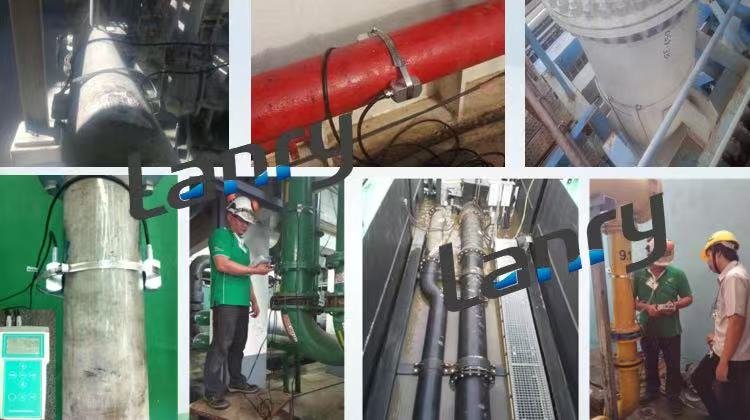
Non-intrusive measurement is one of the most prominent advantages of Doppler ultrasonic flowmeters for slurry applications. Unlike invasive devices that require pipeline modification, these flowmeters use clamp-on sensors mounted externally on the pipeline wall. This design eliminates direct contact with the abrasive slurry, avoiding sensor wear, corrosion, and pipeline leakage risks. Installation is straightforward without disrupting production, making it ideal for retrofitting existing slurry transport systems.
Advanced signal processing technologies enhance the reliability of Doppler ultrasonic flowmeters in complex slurry environments. Innovations like Refractive Spread Spectrum Analysis (RSSA) enable the device to capture and analyze wide-frequency reflected signals, maximizing ultrasonic energy from particles and improving measurement repeatability. These flowmeters also feature strong anti-electromagnetic interference capabilities and adjustable filtering and response time, adapting to varying slurry properties such as particle size (0.1-1000μm) and concentration.
In practical applications, Doppler ultrasonic flowmeters play an indispensable role across multiple industries. In mining, they monitor tailings slurry transport to prevent pipeline blockages caused by insufficient flow velocity. In oil drilling, they accurately measure drilling mud flow to optimize drilling efficiency and ensure wellbore stability. Wastewater treatment plants rely on them to track sludge slurry flow, supporting process control and compliance with environmental regulations. Models like the Flow P-500 series offer versatile installation options (fixed, portable, wall-mounted) and data output interfaces (4-20mA, Modbus RTU RS485), integrating seamlessly with industrial control systems.
Despite their advantages, certain considerations are essential for optimal performance. The slurry must contain an adequate concentration of suspended particles or bubbles to generate effective reflected signals—too few particles may lead to measurement inaccuracies. Pipeline material, wall thickness, and surface condition also affect signal penetration, requiring proper sensor positioning and calibration. Regular maintenance, though minimal compared to traditional meters, includes sensor cleaning and verification to ensure long-term stability.
As industries demand more precise and durable flow measurement solutions, Doppler ultrasonic flowmeters continue to evolve. Their ability to handle harsh slurry conditions, combined with non-intrusive design and advanced signal processing, makes them a preferred choice for modern industrial processes. By providing real-time, reliable flow data, these devices contribute to improved operational efficiency, reduced maintenance costs, and enhanced safety in slurry transport systems.
Post time: Jan-16-2026