

In industrial fluid management, the need for measurement tools that combine accuracy with minimal process disruption has made ultrasonic flowmeters a game-changer. Unlike traditional flow measurement devices—such as turbine meters that require internal components to interact with fluids, or differential pressure meters that risk clogging and contamination—ultrasonic flowmeters operate without penetrating the pipe or touching the fluid itself. This non-invasive design, paired with advanced signal processing technology, allows them to deliver high-precision data, addressing critical pain points in industries ranging from water treatment to oil and gas, and pharmaceutical manufacturing.
The core principle behind ultrasonic flowmeters lies in leveraging sound wave behavior to calculate fluid velocity. Most industrial models rely on two key technologies: transit-time and Doppler effect, each tailored to specific fluid types but equally focused on non-intrusiveness. Transit-time ultrasonic flowmeters use two transducers mounted externally on the pipe’s surface, one transmitting and the other receiving ultrasonic signals. When fluid flows through the pipe, the signal traveling in the direction of the flow (downstream) takes less time to reach the receiver, while the signal moving against the flow (upstream) takes longer. The meter calculates the time difference between these two signals, then uses this data—along with pipe diameter and fluid properties—to compute flow rate with remarkable accuracy, often within ±0.5% of the actual value for clean liquids.
For fluids with suspended particles or bubbles (such as wastewater, slurries, or crude oil), Doppler-effect ultrasonic flowmeters are preferred. These devices emit high-frequency sound waves that bounce off the particles in the fluid; the reflected waves experience a frequency shift (known as the Doppler effect) based on the particles’ velocity, which directly correlates to the fluid’s flow rate. Even with these particles, Doppler meters maintain precision by filtering out background noise, ensuring reliable readings without needing to disrupt the fluid’s flow or expose components to abrasive or corrosive substances.
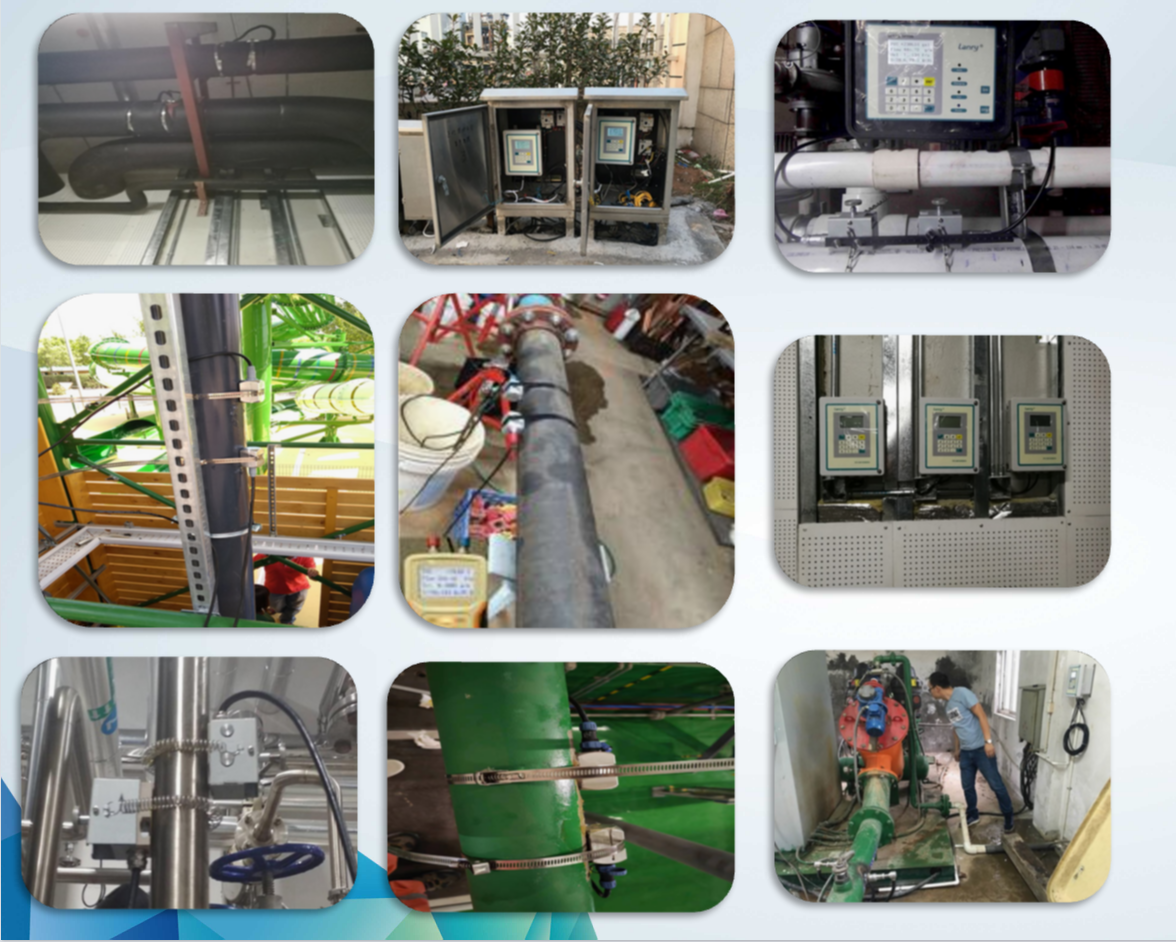
The non-invasive nature of ultrasonic flowmeters brings multiple practical benefits that enhance both efficiency and cost-effectiveness. Installation requires no pipe cutting, welding, or shutdowns—technicians simply attach transducers to the pipe’s exterior, reducing downtime from days (for traditional meters) to hours or even minutes. This is particularly critical in industries like power generation, where interrupting cooling water flow can lead to costly outages. Additionally, since there are no internal parts, ultrasonic meters avoid issues like wear, clogging, or fluid contamination—problems that plague turbine or positive displacement meters. In pharmaceutical manufacturing, for example, this means no risk of metal particles from worn components leaching into ultra-pure,ensuring compliance with strict regulatory standards.
High precision is another defining strength, made possible by advancements in digital signal processing and sensor technology. Modern ultrasonic flowmeters can adjust for variables like temperature, pressure, and pipe material (e.g., steel, PVC, or copper) in real time, correcting for potential signal distortions and maintaining accuracy across changing operating conditions. For instance, in water distribution systems, they can detect even small leaks or fluctuations in flow, helping utilities reduce water waste and optimize network performance. In the oil and gas industry, their ability to measure high-viscosity fluids with precision ensures accurate billing for fuel transportation and prevents revenue loss from measurement errors.
Beyond industrial applications, ultrasonic flowmeters are also gaining traction in residential and commercial settings—such as smart water meters that enable remote monitoring of consumption—thanks to their compact design and low maintenance needs. As sustainability becomes a global priority, their ability to track fluid usage with minimal energy consumption (many operate on low-power batteries) further adds to their appeal.
In conclusion, ultrasonic flowmeters redefine fluid measurement by merging non-invasive convenience with high precision. By eliminating the limitations of traditional devices—from installation downtime to contamination risks—they not only improve operational efficiency but also support compliance, cost savings, and sustainability across industries. As technology continues to advance, their accuracy and versatility will only grow, solidifying their role as a cornerstone of modern fluid management systems.
Post time: Sep-25-2025