

In industrial, environmental, and municipal flow measurement scenarios, Doppler flow meters have emerged as a reliable and versatile solution, distinguished by their unique working principle—leveraging the Doppler effect to calculate flow velocity by detecting frequency shifts of sound waves reflected off particles or bubbles in the fluid. This design endows them with a range of advantages that address the limitations of traditional flow meters, making them indispensable in complex application environments.
1. Exceptional Adaptability to Turbid or Particle-Laden Fluids
Unlike many flow measurement technologies (such as ultrasonic transit-time meters or electromagnetic meters), Doppler flow meters thrive in fluids with suspended solids, bubbles, or high turbidity—conditions that often disrupt other devices. Whether measuring wastewater with sediment, industrial effluents containing sludge, or irrigation water with organic particles, the Doppler principle relies on these particles as "reflectors" for sound waves. This eliminates the risk of signal loss or accuracy degradation, ensuring stable performance in harsh fluid environments where precision is critical for compliance (e.g., environmental wastewater discharge monitoring) or process control (e.g., mining slurry transport).
2. Flexible Installation with Minimal Pipeline Modification
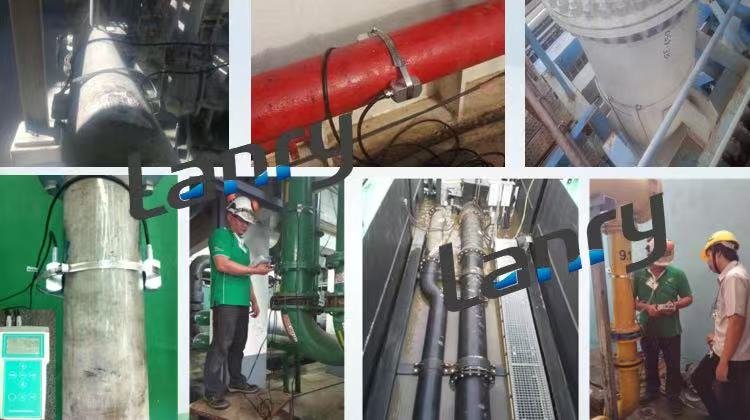
Doppler flow meters support both inline and clamp-on installation, offering unmatched flexibility for existing or new pipeline systems. Clamp-on models, in particular, require no cutting of pipes, no shutdown of operations, and no direct contact with the fluid—avoiding risks of leakage, contamination, or process interruption. This is a game-changer for retrofitting projects (e.g., upgrading old municipal water networks) or industries where pipeline integrity is non-negotiable (e.g., food processing, pharmaceutical manufacturing). Even inline models feature compact designs that fit small-diameter pipes (down to DN25), reducing space requirements and installation complexity compared to bulky mechanical meters.
3. Low Maintenance Requirements and Long Service Life
With no moving parts in contact with the fluid, Doppler flow meters minimize wear, fouling, and mechanical failure—common pain points of traditional turbine or positive-displacement meters. The absence of internal components (such as rotors or electrodes) means there is no risk of clogging by particles or corrosion from aggressive fluids. Routine maintenance typically only involves cleaning the external transducers (for clamp-on models) or occasional calibration, cutting down on downtime and operational costs. In industrial settings with 24/7 operations (e.g., chemical plants, power stations), this reliability translates to consistent long-term performance, often with a service life of 8–10 years or more.
4. High Accuracy Across Variable Flow Conditions
Modern Doppler flow meters integrate advanced signal processing technologies (such as adaptive filtering and digital signal amplification) to deliver precise measurements even in fluctuating flow environments. They maintain accuracy within ±1% to ±3% of the measured value across a wide turndown ratio (up to 1:100), covering both low and high flow rates. This is particularly valuable in applications with variable demand, such as stormwater monitoring (where flow rates spike during rainfall) or industrial batch processing (where flow changes with production cycles). Unlike some meters that require stable, straight pipe runs, Doppler models tolerate moderate flow disturbances (e.g., bends, valves nearby), reducing the need for costly pipeline modifications to optimize flow conditions.
5. Cost-Effectiveness for Diverse Applications
Compared to specialized meters designed for harsh fluids (e.g., corrosion-resistant electromagnetic meters for acidic effluents), Doppler flow meters offer a more cost-effective solution without compromising performance. Their adaptability to multiple fluid types eliminates the need to invest in different meters for different processes—for example, a single Doppler meter can measure both wastewater and cooling water in a manufacturing plant. Additionally, the low installation and maintenance costs further lower the total cost of ownership, making them accessible for small to medium-sized enterprises (SMEs) and large industrial facilities alike.
Conclusion
Doppler flow meters stand out in modern flow measurement for their ability to handle complex fluids, flexible installation, low maintenance, and reliable accuracy—addressing the most pressing challenges of diverse industries. From environmental monitoring to industrial process control, their unique advantages make them a preferred choice for applications where traditional meters fall short. As technology advances, further improvements in signal processing and connectivity (e.g., IoT integration for real-time data monitoring) will only enhance their value, solidifying their role in efficient, data-driven flow management.
Post time: Nov-12-2025