

Investing in an ultrasonic flowmeter is a critical decision for industries ranging from water treatment to oil and gas, as it directly impacts operational efficiency, measurement accuracy, and long-term cost-effectiveness. Unlike traditional flowmeters, ultrasonic models rely on sound wave technology—making their performance highly dependent on specific technical specifications. Overlooking key parameters can lead to mismatched tools, frequent downtime, or non-compliance with industry standards. To ensure a strategic investment, buyers must prioritize six core specifications that align with their unique application needs.
First and foremost, measurement accuracy and repeatability are non-negotiable. Accuracy refers to how closely the meter’s readings match the actual fluid flow rate, typically expressed as a percentage of full scale (e.g., ±0.5% of FS) or a percentage of the reading (e.g., ±0.2% of reading). Repeatability, by contrast, measures the consistency of readings under the same conditions—a critical factor for processes requiring stable, predictable data (such as pharmaceutical manufacturing or chemical dosing). For clean liquids like drinking water, transit-time ultrasonic flowmeters often deliver accuracy within ±0.5%, while Doppler models (for particle-laden fluids like wastewater) may range from ±1% to ±3%. Buyers should avoid overspecifying accuracy (which increases costs) but ensure it meets regulatory requirements—for example, oil and gas companies may need ISO 5167-compliant accuracy for custody transfer.
Second, fluid compatibility determines whether the meter can withstand the properties of the fluid being measured. Two key sub-specifications here are wetted material and temperature/pressure range. Wetted parts (components in direct contact with the fluid) must resist corrosion, erosion, or chemical degradation. For aggressive fluids like acids or solvents, meters with wetted parts made of PTFE or PFA are ideal, while stainless steel works for neutral liquids like water. Additionally, the meter’s operating temperature and pressure ranges must match the process conditions: a flowmeter rated for -20°C to 80°C will fail in high-temperature applications like steam lines, just as one designed for 10 bar pressure cannot handle offshore oil pipelines operating at 100 bar. Mismatched temperature/pressure ratings not only reduce accuracy but also pose safety risks like leaks or component failure.
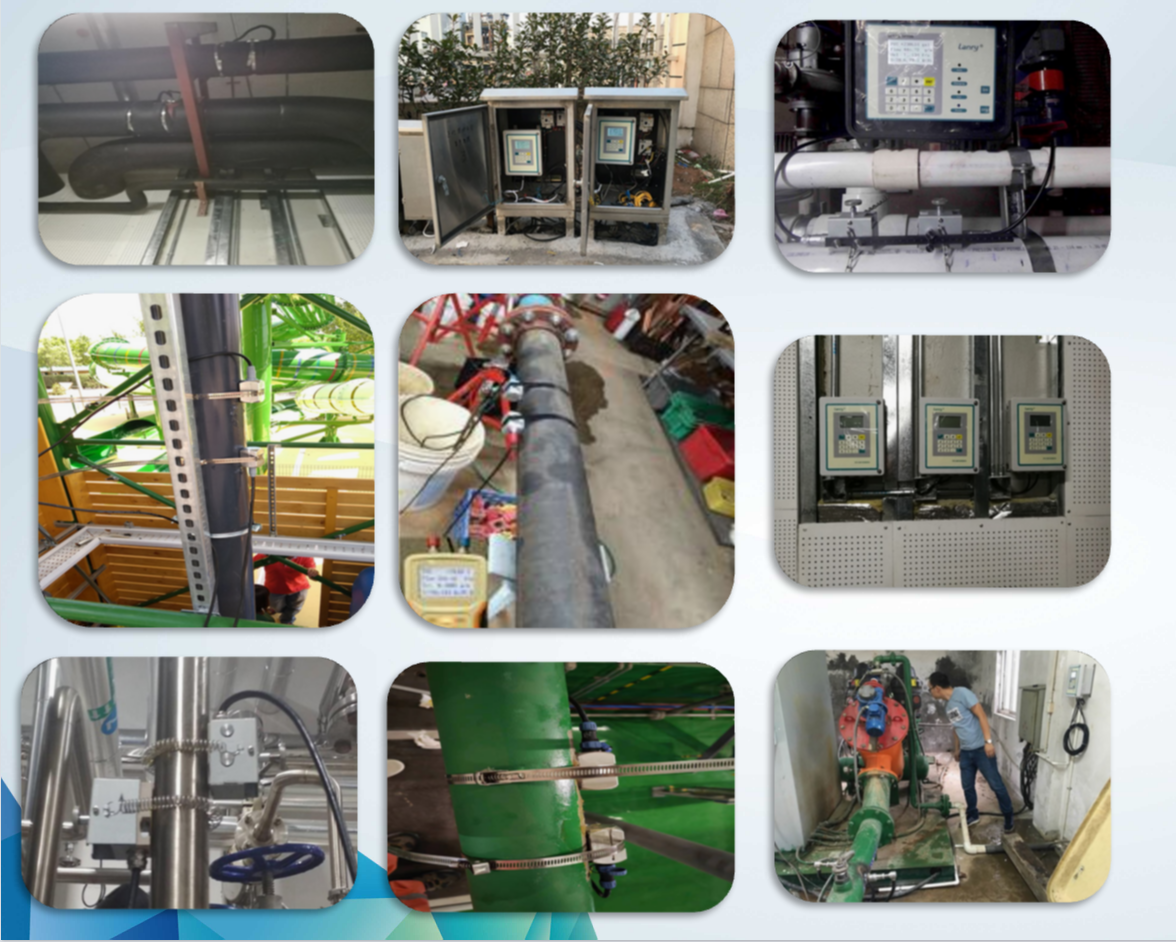
Third, pipe size and installation flexibility directly affect usability. Ultrasonic flowmeters are available for pipe diameters ranging from 10 mm (for laboratory use) to 3,000 mm (for large-scale water distribution). Choosing the wrong size leads to inaccurate readings—for example, a meter designed for 500 mm pipes will struggle to measure flow in 50 mm pipes due to signal distortion. Installation type (clamp-on vs. inline) is another key factor: clamp-on models are non-invasive, require no pipe cutting, and suit retrofits or delicate pipes (e.g., PVC), while inline models offer higher accuracy for critical processes but need shutdowns for installation. Buyers should also check if the meter supports horizontal/vertical installation, as some models perform poorly when mounted vertically with downward flow.
Fourth, output and communication protocols ensure the meter integrates with existing systems. Modern ultrasonic flowmeters offer various outputs: analog (4-20 mA) for real-time flow rate transmission, pulse outputs for total flow counting, and digital outputs (RS485, Modbus, or HART) for connectivity to SCADA, PLCs, or cloud-based monitoring platforms. For smart factories or remote sites, wireless protocols like LoRaWAN or Wi-Fi are essential to enable remote data access and predictive maintenance. A meter lacking compatible communication options will require costly adapters or manual data entry, undermining operational efficiency.
Fifth, power requirements and environmental resilience are vital for harsh or off-grid environments. Most industrial meters run on 24 VDC or 110/230 VAC, but battery-powered models are available for remote locations (e.g., rural water pipelines) and can operate for 5-10 years on a single battery. Environmental resilience is measured by ingress protection (IP) ratings and operating temperature range: an IP68 rating ensures dust tightness and water submersion, making it suitable for outdoor or wet areas, while an IP65 rating works for indoor, dusty environments. For extreme cold (e.g., Arctic oil fields) or heat (e.g., desert solar plants), meters with extended temperature ranges (-40°C to 120°C) are necessary to avoid electronic component failure.
Finally, maintenance needs and lifecycle cost impact long-term value. Ultrasonic flowmeters have fewer moving parts than turbine meters, but they still require periodic checks—such as calibrating transducers or cleaning sensors (for Doppler models). Buyers should compare maintenance intervals (e.g., annual vs. biennial calibration) and costs, as well as the availability of replacement parts. A meter with a lower upfront cost but frequent, expensive maintenance may end up being more costly over 5-10 years than a higher-priced, low-maintenance alternative.
In conclusion, investing in an ultrasonic flowmeter requires a targeted focus on specifications that align with application needs—from accuracy and fluid compatibility to communication protocols and lifecycle cost. By avoiding one-size-fits-all decisions and prioritizing parameters that directly impact performance and compliance, buyers can select a meter that delivers reliable data, reduces downtime, and provides long-term value. In an era of increasing industrial automation, the right ultrasonic flowmeter is not just a measurement tool—it is a cornerstone of efficient, sustainable operations.
Post time: Sep-25-2025