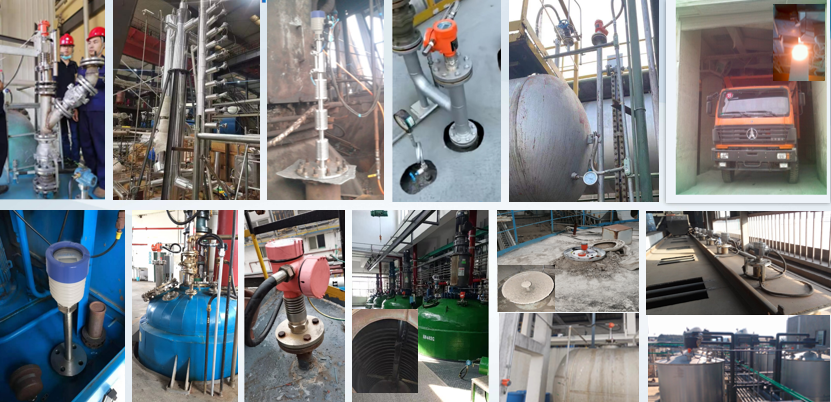
In industrial operations—from oil refineries storing crude oil to grain facilities managing silos of wheat, and wastewater plants monitoring sludge tanks—accurate level measurement is critical. It ensures safe storage, optimizes inventory management, prevents overflows or dry runs, and supports seamless production workflows. However, traditional level measurement tools like ultrasonic sensors, float switches, or pressure transmitters often struggle in harsh or complex environments: ultrasonic signals are blocked by dust or vapor, floats get stuck in viscous fluids, and pressure transmitters fail in tanks with varying temperatures or corrosive media. Enter the non-contact radar level transmitter—a game-changing solution that delivers unmatched accuracy for tank and silo level measurement, even in the most challenging conditions.
At its core, a non-contact radar level transmitter operates on the principle of time-of-flight (ToF). It emits high-frequency radar pulses (typically 24GHz or 80GHz) from an antenna mounted at the top of a tank or silo. These pulses travel downward, reflect off the surface of the liquid, solid, or slurry inside, and bounce back to the transmitter. The device calculates the time taken for the pulses to travel to the surface and return, then uses this data (along with the speed of radar waves) to compute the exact distance to the material—from which it derives the current level. Unlike contact-based tools, it never touches the measured medium, eliminating the risk of wear, contamination, or mechanical failure.
What sets this technology apart is its exceptional accuracy, a key requirement for tank and silo applications where even small measurement errors can lead to costly consequences. Most non-contact radar level transmitters boast an accuracy of ±1mm to ±5mm, depending on the model and measuring range (which can span from as low as 0.3 meters to as high as 80 meters). This precision holds even in dynamic scenarios: for example, in oil tanks with turbulent surfaces or silos with flowing granular materials like cement or plastic pellets. Advanced features like echo filtering and signal processing algorithms further enhance accuracy by ignoring false reflections from tank walls, internal structures (such as agitators or baffles), or dust clouds—common issues that plague other measurement tools.
Another advantage of non-contact radar transmitters is their versatility across tank and silo environments. They handle a wide range of media: liquids (including hydrocarbons, chemicals, and water), solids (grains, powders, and pellets), and even difficult-to-measure slurries (like wastewater sludge or mining tailings). Their robust design stands up to extreme conditions: high temperatures (up to 200°C or more with specialized models), high pressures (up to 100 bar), and corrosive atmospheres—making them ideal for industries like petrochemicals, food and beverage, and mining. Many models also come with IP67 or IP68 protection ratings, ensuring resistance to dust, water, and moisture, which is essential for outdoor silos or wet processing facilities.
For industrial operators, the benefits extend beyond accuracy and durability to operational efficiency. Non-contact radar transmitters require minimal maintenance: without moving parts or contact with the medium, there’s no need for regular cleaning, calibration, or part replacements—unlike float switches that need frequent servicing or pressure transmitters prone to clogging. They also integrate seamlessly with existing control systems via standard protocols like Modbus, HART, or 4-20mA analog output. This means level data can be transmitted in real time to SCADA systems, inventory management software, or cloud-based platforms, allowing operators to monitor levels remotely, set automated alerts for low/high levels, and make data-driven decisions about refilling or emptying tanks/silos.
Consider a large grain elevator with dozens of silos storing wheat and corn. A non-contact radar level transmitter mounted on each silo provides accurate, real-time level data, enabling the facility to track inventory without manual inspections (which are time-consuming and risky). If a silo nears capacity, the system triggers an alert to stop incoming grain, preventing overflow. In an oil refinery, radar transmitters on crude oil tanks ensure precise measurement of stored volumes, supporting compliance with regulatory reporting requirements and optimizing the scheduling of tanker deliveries.
In conclusion, the non-contact radar level transmitter has redefined tank and silo level measurement. Its non-contact design eliminates the flaws of traditional tools, its high accuracy minimizes operational risks, and its versatility adapts to diverse industrial needs. For businesses looking to enhance safety, streamline inventory management, and improve overall efficiency, this technology is not just a measurement tool—it’s a critical asset that drives reliability and productivity in modern industrial operations.