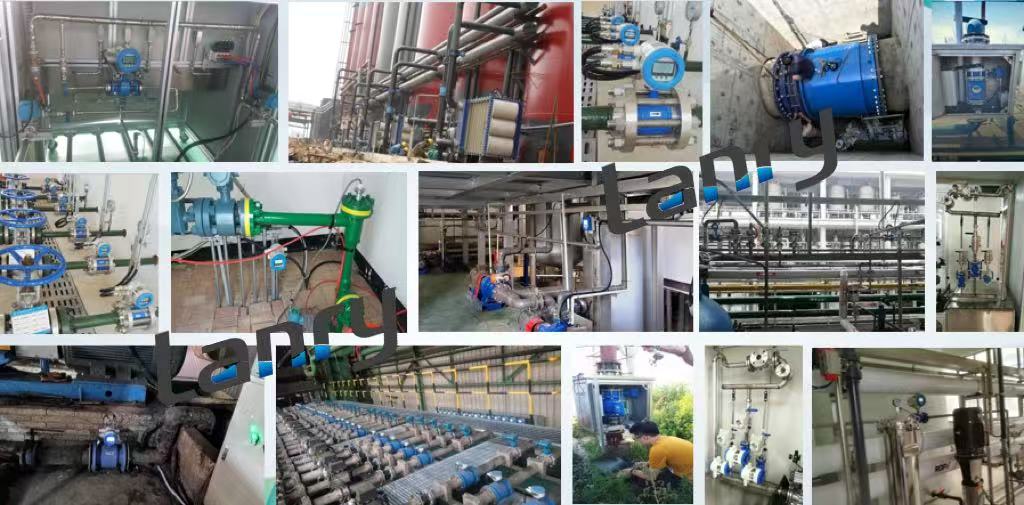
In the field of fluid measurement and process control, electromagnetic flowmeters (EM flowmeters) have become a cornerstone technology, celebrated for their accuracy, versatility, and adaptability to complex fluid conditions. Rooted in Faraday’s Law of Electromagnetic Induction, these devices measure the flow rate of conductive fluids without relying on moving parts, eliminating issues like mechanical wear, clogging, and accuracy degradation that plague traditional flowmeters. This unique set of advantages has propelled their adoption across diverse industries worldwide—from municipal water management and industrial manufacturing to environmental monitoring and energy production. By examining their applications in both domestic (e.g., within major markets like China, the United States, and Europe) and international contexts, we can gain a comprehensive understanding of how EM flowmeters are shaping efficient, sustainable, and reliable fluid management systems on a global scale.
I. Domestic Applications: Tailored to Regional Industry Needs
1. Municipal Water and Wastewater Management
In densely populated countries like China and India, municipal water supply and wastewater treatment are critical priorities, and EM flowmeters play a pivotal role in optimizing these systems. In China, for instance, the government’s “Sponge City” initiative—aimed at improving urban water resilience—relies heavily on EM flowmeters to monitor water distribution in pipelines, track sewage flow in treatment plants, and measure rainwater harvesting efficiency. Unlike mechanical flowmeters, EM devices can handle the high turbidity and sediment content common in China’s urban wastewater, ensuring accurate data for leak detection and demand forecasting. In cities like Shanghai and Beijing, EM flowmeters are integrated into smart water networks, enabling real-time remote monitoring of water usage across residential, commercial, and industrial zones. This not only reduces non-revenue water (NRW) — a longstanding challenge for Chinese utilities — but also supports data-driven decisions to allocate water resources more equitably.
In the United States, municipal applications of EM flowmeters focus on compliance with strict environmental regulations, such as the Clean Water Act. Cities like New York and Los Angeles use EM flowmeters in wastewater treatment plants to measure the flow of untreated sewage into treatment facilities and the discharge of treated effluent into rivers or oceans. The devices’ ability to maintain accuracy in varying flow rates (from low trickles during dry seasons to high surges after heavy rains) ensures that utilities meet discharge limits and avoid costly fines. Additionally, in regions prone to drought, such as California, EM flowmeters are used to monitor agricultural irrigation water usage, helping state authorities enforce water conservation mandates while ensuring farmers receive accurate billing for their water consumption.
2. Industrial Manufacturing
Within domestic industrial sectors, EM flowmeters are tailored to address industry-specific challenges. In Germany, a global leader in automotive and chemical manufacturing, EM flowmeters are integral to precision processes. Automotive plants use them to measure the flow of coolants, lubricants, and paint formulations—fluids that often contain suspended particles or additives that would clog mechanical meters. The accuracy of EM devices ensures consistent product quality, as even minor variations in fluid flow can affect the performance of car components. In chemical plants across Germany, EM flowmeters handle corrosive fluids (such as acids and solvents) thanks to their corrosion-resistant flow tubes (lined with PTFE or ceramic), preventing leaks and ensuring worker safety.
In Japan, a hub for electronics and semiconductor manufacturing, EM flowmeters are used in ultra-pure water systems critical to chip production. Semiconductor fabrication requires water with near-zero impurities, and EM flowmeters—with their smooth, non-obstructed flow paths—avoid contaminating the water while providing precise flow data. This is essential for processes like wafer cleaning, where even tiny particles can render chips defective. Japanese manufacturers also rely on EM flowmeters in food and beverage production, such as in sake breweries, to measure the flow of rice mash and water, ensuring consistency in flavor and alcohol content while complying with strict food safety standards.
II. International Applications: Cross-Border Solutions for Global Challenges
1. Oil and Gas Industry
The global oil and gas sector relies on EM flowmeters to address the unique challenges of measuring hydrocarbon fluids, which are often viscous, corrosive, or contain sand and debris. In the Middle East—home to the world’s largest oil reserves—EM flowmeters are used in upstream operations (oil extraction) to measure the flow of crude oil from wells to pipelines. Unlike turbine meters, which can be damaged by sand particles in crude oil, EM devices have no moving parts, making them durable in harsh desert conditions. In downstream operations, such as refineries in Saudi Arabia and the United Arab Emirates, EM flowmeters measure the flow of refined products (like gasoline and diesel) during blending and distribution, ensuring accurate dosing of additives and compliance with international fuel quality standards.
In offshore oil fields, such as those in the North Sea (operated by companies from the UK, Norway, and the Netherlands), EM flowmeters are deployed in subsea pipelines to measure oil and gas flow. These devices are designed to withstand extreme pressure (up to 10,000 psi) and low temperatures, and their non-contact design eliminates the risk of mechanical failure in remote, hard-to-maintain locations. Real-time data from EM flowmeters helps operators optimize production rates and detect leaks early, minimizing environmental damage and financial losses—critical in ecologically sensitive areas like the North Sea.
2. Environmental Monitoring and Sustainability
On a global scale, EM flowmeters are key tools in addressing climate change and environmental protection, with applications spanning cross-border projects. The European Union’s Water Framework Directive (WFD), which aims to restore and maintain good ecological status of all water bodies across Europe, relies on EM flowmeters to monitor river discharge, groundwater recharge, and the flow of pollutants from industrial sites into waterways. For example, in the Danube River Basin—shared by 19 countries—EM flowmeters are installed at border checkpoints to measure the flow of water and detect illegal discharges, enabling cross-country collaboration to reduce pollution. The devices’ ability to measure both clean and contaminated water ensures that data is reliable, even in regions with high industrial activity.
In developing countries across Africa and Southeast Asia, EM flowmeters are supporting international aid projects focused on clean water access. Organizations like the United Nations Children’s Fund (UNICEF) use EM flowmeters in rural water supply systems to measure the flow of water from boreholes to community taps, ensuring that resources are distributed evenly and that systems are operating efficiently. In regions like Kenya’s Rift Valley, where water scarcity is widespread, EM flowmeters help track water usage patterns, allowing aid groups to design more targeted conservation programs. Additionally, in Southeast Asia’s Mekong River Basin, EM flowmeters are used to monitor the impact of hydropower dams on river flow, providing data to international bodies that regulate dam construction to protect fish populations and local communities dependent on the river for livelihoods.
III. Comparing Domestic and International Applications: Convergence and Divergence
While the core functionality of EM flowmeters remains consistent globally, their applications reflect regional priorities and industry needs. In developed countries (e.g., the US, Europe, Japan), applications often emphasize compliance with strict regulations (environmental, safety, quality) and integration with smart, automated systems. For example, European manufacturers prioritize EM flowmeters with digital communication protocols (like Profinet or WirelessHART) to connect to Industry 4.0-enabled factories, while US utilities focus on devices that support advanced leak detection algorithms.
In contrast, in developing countries (e.g., India, Kenya, Vietnam), applications are more focused on basic efficiency and resource accessibility. EM flowmeters are used to reduce water waste, ensure equitable distribution, and support low-cost infrastructure projects—often with simpler, more cost-effective models that prioritize durability over advanced digital features. However, there is a growing convergence as developing countries adopt smart technologies: for instance, China’s integration of EM flowmeters into smart cities mirrors similar efforts in Europe, while India’s recent push for “Digital India” has led to increased adoption of EM flowmeters with remote monitoring capabilities in urban water systems.
Another key divergence lies in industry focus: in oil-rich regions like the Middle East, EM flowmeters are heavily concentrated in the energy sector, while in manufacturing hubs like Germany and Japan, they dominate industrial processes. In agricultural economies like Brazil, EM flowmeters are used primarily in irrigation systems to optimize water usage for crops like soybeans and coffee, reflecting the country’s reliance on agriculture for economic growth.
Conclusion
Electromagnetic flowmeters have transcended regional boundaries to become a universal solution for fluid measurement, driven by their accuracy, versatility, and adaptability. From China’s smart cities and Germany’s automotive factories to the Middle East’s oil fields and Africa’s rural water systems, EM flowmeters are addressing unique regional challenges while contributing to global goals of sustainability, efficiency, and resource equity. As industries worldwide continue to adopt smart technologies and stricter environmental regulations, the demand for EM flowmeters will only grow—further solidifying their role as a cornerstone of modern fluid management. Whether in domestic or international settings, these devices prove that innovation in measurement technology is not just about precision, but about empowering communities, industries, and nations to use resources more wisely in a rapidly changing world.