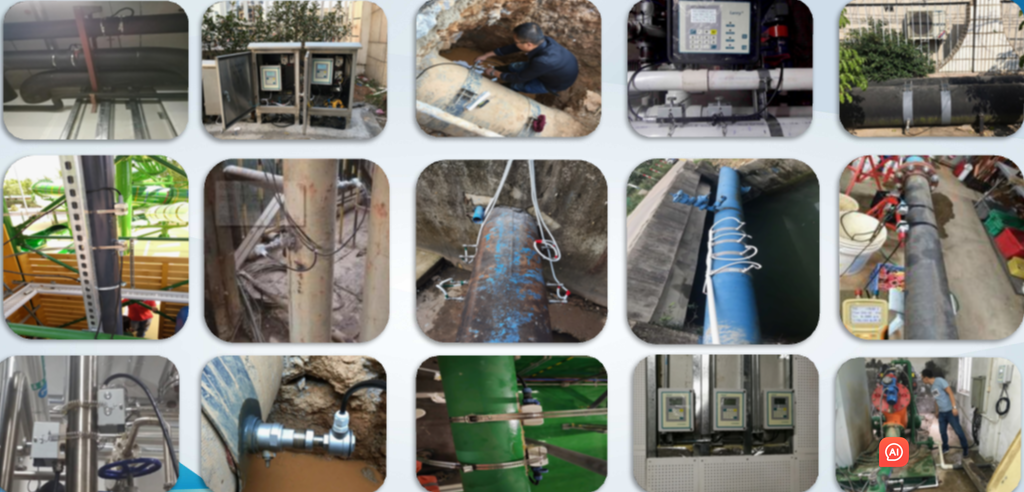
In the realm of industrial and municipal fluid management, where accuracy, durability, and adaptability are paramount, transit-time ultrasonic flow meters have established themselves as a gold standard. Unlike mechanical meters with moving parts or Doppler ultrasonic meters (which rely on suspended particles in fluids), transit-time models leverage the subtle difference in ultrasonic wave travel time to calculate flow rate—offering unmatched precision for clean, homogeneous fluids. From potable water distribution to pharmaceutical manufacturing, these meters excel in scenarios where even minor measurement errors can disrupt operations, inflate costs, or compromise compliance. By combining non-intrusive design, long-term reliability, and advanced data capabilities, transit-time ultrasonic flow meters are redefining how industries monitor and optimize fluid flow.
At the core of transit-time ultrasonic flow meters’ effectiveness is their elegant, physics-based operating principle, which eliminates the limitations of traditional measurement tools. Here’s how it works: Most models feature two transducers mounted on opposite sides of a pipe (either internally or externally). One transducer acts as an emitter, sending high-frequency ultrasonic waves through the fluid toward the second transducer (the receiver). This process then reverses: the second transducer emits waves back to the first. When fluid is flowing, the waves traveling with the current move faster, while those traveling against the current slow down. The meter’s onboard processor calculates the “time difference” between these two wave journeys; using this difference, along with known variables like pipe diameter and fluid properties, it computes flow rate and total volume with exceptional accuracy.
This design offers two critical advantages over mechanical meters. First, there are no moving parts—no impellers, gears, or pistons to wear down, clog, or require regular replacement. Mechanical meters often lose precision after 3–5 years of use (especially with abrasive fluids), but transit-time models maintain accuracy for a decade or more, even in continuous operation. Second, the non-intrusive (or minimally intrusive) installation means no disruption to fluid flow and no risk of leaks or contamination—a game-changer for industries like food and beverage or pharmaceuticals, where product purity is non-negotiable. For a municipal water utility, this translates to fewer service calls, lower maintenance costs, and consistent billing accuracy for thousands of customers.
Transit-Time ultrasonic flow meters stand out for their exceptional precision and versatility, making them suitable for a wide range of applications. Unlike Doppler meters (which require fluids to contain particles or bubbles to reflect waves), transit-time models perform optimally with clean, homogeneous fluids—from drinking water and natural gas to chemicals and pharmaceuticals. Their accuracy is unmatched: most industrial-grade models achieve ±0.5% to ±1% of full scale, even at very low flow rates (as low as 0.1 m/s). This level of sensitivity is critical for processes where precise flow control directly impacts product quality. For example, in a pharmaceutical plant blending liquid ingredients, a slight deviation in flow rate could render a batch unsafe; transit-time meters ensure consistent dosing, reducing waste and ensuring regulatory compliance.
Beyond clean fluids, modern transit-time meters are also adaptable to challenging conditions. Many models feature corrosion-resistant transducers (made from materials like titanium or PTFE) and can handle a wide range of temperatures (from -40°C to 200°C) and pressures (up to 100 bar), making them suitable for oil and gas pipelines, industrial cooling systems, and even high-temperature chemical processes. This versatility eliminates the need for multiple meter types across different operations, simplifying inventory management and staff training.
In an era of smart infrastructure, transit-time ultrasonic flow meters also excel at data integration and remote monitoring—driving efficiency and proactive maintenance. Most modern models are equipped with digital outputs (such as 4–20 mA, Modbus, or Profinet) and can connect to IoT platforms via wireless technologies like LoRaWAN or NB-IoT. This enables real-time flow data tracking, remote reading, and automated alerts for abnormal conditions (e.g., sudden flow spikes or drops indicating a leak or blockage). For a manufacturing plant, this means operators can monitor flow rates across multiple production lines from a central dashboard, identifying inefficiencies (like excessive water use in a cooling system) and adjusting processes to reduce waste. For a utility company, remote monitoring eliminates the need for manual meter reading—a labor-intensive task that often leads to errors—cutting operational costs by 25% or more. It also allows for predictive maintenance: by analyzing historical flow data, the utility can anticipate when a meter might need calibration, avoiding unplanned downtime.
As industries face growing pressure to reduce waste, improve sustainability, and meet strict regulatory standards, transit-time ultrasonic flow meters have become an indispensable tool. Their non-intrusive design ensures long-term reliability, their precision safeguards product quality and compliance, and their smart capabilities enable data-driven decision-making. Whether used to monitor drinking water distribution, optimize industrial processes, or ensure pharmaceutical purity, these meters prove that fluid measurement can be both accurate and efficient. In a world where every drop, liter, or gallon counts, transit-time ultrasonic flow meters are more than just instruments—they are partners in building sustainable, efficient, and resilient operations. For any organization seeking to elevate its fluid management systems, investing in transit-time ultrasonic flow meters is not just an upgrade—it’s a commitment to excellence.