

1. What Is an Ultrasonic Water Meter?
Ultrasonic water meters measure flow by timing ultrasonic pulses traveling with and against the water—no impeller, no moving parts, and essentially no pressure loss. Compared with mechanical meters, they offer wider rangeability (R250–R500+ vs R80–R160), much lower start flow, built-in communications, and stable accuracy across a 10-year battery life. If your utility is rotating out aging mechanical meters, rolling out DMA zones, or building an AMI network, ultrasonic is no longer a niche choice—it is the default starting point. This guide walks through how they work, how they compare to mechanical meters, and the four decisions (size, communications, certification, battery) you need to make before you specify one.


2. How an Ultrasonic Water Meter Works?
An ultrasonic water meter is fully electronic. Two transducers sit on opposite sides of the measuring tube and alternately fire ultrasonic pulses through the water. The pulse traveling downstream arrives slightly faster than the pulse traveling upstream, and the time difference between the two is proportional to the average flow velocity. The meter's electronics convert that time difference into volumetric flow and totalize it.
There is no impeller, no turbine, no piston, and no obstruction in the flow path. Water passes straight through the measuring tube, which is why these meters add essentially zero pressure loss and are not subject to the wear and fouling that degrades mechanical accuracy over time.
Many bulk and premium residential models use dual-channel construction—two pairs of transducers on separate acoustic paths across the pipe. Two paths average out velocity-profile asymmetries caused by bends, partial obstruction, or non-ideal straight pipe, which is why dual-channel designs are preferred on larger diameters where flow profile distortions are most damaging. (For non-potable or industrial water applications, the same transit-time principle is used in clamp-on ultrasonic flow meters mounted on the outside of existing pipes.)
3. Ultrasonic vs Mechanical Water Meters
Mechanical meters—rotary piston, single-jet, multi-jet, and Woltmann/turbine designs—have dominated water utilities for over a century. They are cheap, familiar, and easy to read. But after years in service they drift. Impellers wear, scale and sediment build up on bearings, and grit abrades the measuring chamber; the result is a meter that starts under-registering, especially at low flows.
An ultrasonic meter removes the moving parts entirely. The tradeoffs that matter for a procurement decision are:
| Compared Items | Panda Residential Ultrasonic Water Meters | Other Mechanical Residential Water Meters With Remote Transmission Function |
|---|---|---|
| Mechanical Wear | The flow measurement components are electronic components and there are no measurement problems caused by mechanical wear. | The flow measuring element is a mechanical element (impeller), Mechanical wear is inevitable during long-term use. |
| Starting Flow | 0.8L/h | 5L/h |
| Battery Life | 8 Years+ (1time/day), Max 10years | 6 Years (1time/day) |
| Antimagnetic Grade | E2 | E1 |
| Accuracy | Class 2 | Class 2 |
| Range | 500≥R≥100 | R≤100 |
| Remote Display Resolution | 0.0001m³/h | 0.01m³/h |
| Pressure Loss | 0.025Mpa≤P1≤0.063Mpa | 0.063Mpa |
| Smart Functions | Intelligent terminal, integrating measurement medium temperature alarm, air pipe monitoring, backflow warning, equipment abnormality, etc. | Can only transmit data remotely. |
| Installing | Can be installed vertically or tilted | Requires horizontal installation |
| Anti-rotation | The terminal can effectively identify the rotation phenomenon under unstable water pressure through a special algorithm (the water meter is equipped with a check valve connector) | When the water pressure is unstable, the base gear is prone to self-rotation and even negative rotation. |
| Protection Class | The whole device and its components all reach IP68, with superior waterproof and moisture-proof performance. | The base water meter and remote transmission module are divided into two parts, which is difficult to meet IP68 |
| Metric Stability | Stable metering and superior small flow metering performance. | Metering is greatly affected by the impeller, and the low flow tracking ability is poor. It is prone to problems such as low flow or short-term intermittent water not being measured. |
4. Choosing the Right Size — Residential to Bulk
Ultrasonic water meters cover a wide diameter range, but they are not interchangeable across it. The WM9100 line illustrates the usual split:
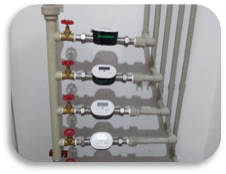
DN15–DN25 (residential): Apartment, single-family, and small commercial connections. This is where battery life and AMI integration matter most. A prepaid variant (e.g., the WM9100-EV) integrates a control valve for landlord/utility prepayment and cut-off scenarios.
DN32–DN40: Light commercial, villa clusters, and small district inlets.
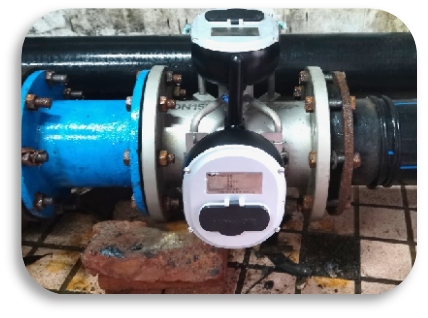
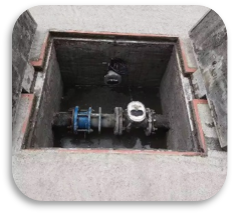
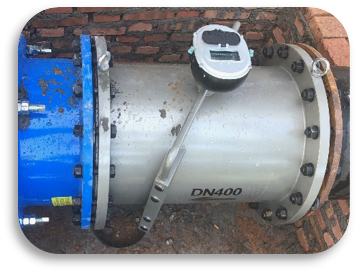
DN50–DN300 (bulk): Commercial building totals, residential compound inlet meters, and DMA sub-zones. Dual-channel construction is standard here to handle distorted flow profiles.
DN350–DN600 (bulk / trunk): Trunk mains, DMA primary zone meters, and treatment-plant outlet metering.
The sizing rule of thumb is to pick the meter such that the customer's normal operating flow lands comfortably in the middle of the meter's Q2–Q3 range, rather than matching the pipe diameter mechanically. A 20 mm connection with very low nighttime demand may be over-served by a meter sized only for peak hour.
Battery life on residential low-power ultrasonic models is commonly specified at 10 years of continuous operation with periodic reporting; bulk life depends heavily on communication frequency and is a question to ask the vendor explicitly.
FAQ
How long does the battery in an ultrasonic water meter last?
Residential low-power ultrasonic meters are commonly specified at 10 years of continuous operation with periodic reporting; bulk meters with frequent reporting may have shorter intervals and should be confirmed per datasheet.
Can ultrasonic water meters be installed in flooded pits?
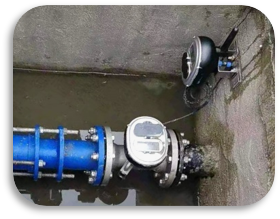
IP68-sealed ultrasonic meters are designed for long-term submersion in underground pits and humid vaults; this is a practical advantage over mechanical meters, which are commonly rated IP65 or lower.
Are ultrasonic water meters accurate enough for billing?
Yes. Models meeting ISO 4064 / OIML R49 with R250/R400 classes hold ±1–2% in the Q2–Q4 flow band and are accepted for custody measurement under MID 2014/32/EU.
What is the difference between a prepaid and a standard ultrasonic water meter?
Prepaid models (such as the WM9100-EV) integrate a shut-off valve and a prepaid/remote-disconnect function, suited to rental housing, landlord-managed buildings, and prepayment tariff programs. Standard models just meter and report.
Do ultrasonic water meters work with our existing AMI platform?
They do, provided the module matches your network: RS485/M-bus wires into existing SCADA/RTU systems, while NB-IoT and LoRaWAN modules push data to cloud AMI platforms directly.
Hello, I'm Michael Yang, Sales Engineer at Lanry Instruments. With over 8 years of hands-on experience in the flow-measurement industry, I draw on deep technical expertise to deliver targeted sales technical advice and optimized product configurations to maximize measurement performance for your industrial customers. Feel free to contact my WhatsApp.
Post time: Oct-23-2026