

Open channel flow meters are specialised measuring instruments designed to calculate liquid flow in open channels, sewers and ditches with a free liquid surface exposed to the atmosphere. Unlike closed-pipe flowmeters deployed for pressurised pipeline systems, open channel meters cater to unenclosed liquid measurement applications, covering municipal wastewater, agricultural irrigation, industrial effluent discharge and stormwater monitoring. They have become indispensable tools for environmental compliance, water resource management and water utility operation worldwide.
The core measurement logic follows the fundamental hydraulic formula: flow rate Q equals the product of the wetted cross-sectional area (A) and average flow velocity (V), expressed as Q=A×V. There are two mainstream technical routes for practical deployment. The first method relies on primary hydraulic structures such as Parshall flumes, rectangular weirs and V-notch weirs. These structures create a stable critical flow condition, where the upstream water level has a fixed mathematical correlation with volumetric flow. An ultrasonic or radar sensor mounted above the water surface measures the liquid level, and the transmitter converts the level reading into flow volume using pre-programmed hydraulic equations. This solution delivers stable repeatability and is widely adopted in fixed monitoring stations at wastewater treatment plants.
The second approach is the area-velocity method. It directly measures both water level and flow velocity without requiring a weir or flume. Ultrasonic Doppler, transit-time or radar sensors capture real-time velocity, while a level sensor calculates the flow cross-section based on channel geometry. This technology shines for retrofitting existing sewers, irregular natural channels and sites where civil construction for flumes is costly or impossible. It adapts better to fluctuating water depth and backwater conditions, which are common in combined sewer overflow monitoring projects.
Ultrasonic open channel flow meters remain the most popular option in the market for their non-contact nature. The transducer sends acoustic pulses toward the water surface and calculates distance by recording signal time-of-flight. Since the sensor sits above the liquid, it avoids direct contact with sewage, sludge, debris and corrosive effluents. This greatly reduces fouling, clogging and abrasion problems, cutting long-term maintenance work. Radar open channel meters are another proven alternative. Microwave signals are less affected by temperature drift, foam and water vapour, making them suitable for harsh environments where ultrasonic signals may suffer interference.
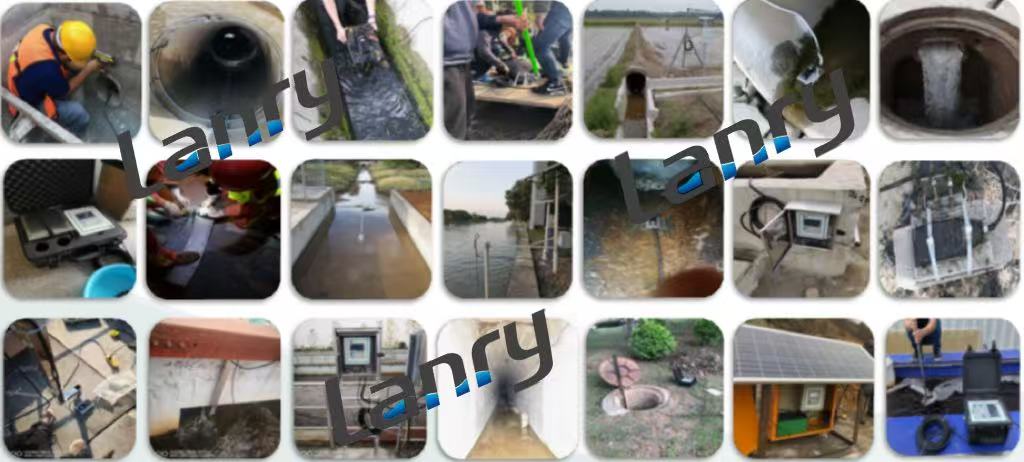
Open channel flow meters serve a broad spectrum of industries. In municipal water and wastewater sectors, they measure inlet and outlet flow at treatment plants and track sewer overflow volumes to meet environmental reporting regulations. In agriculture, irrigation districts deploy these meters along canals to allocate water resources and calculate water consumption for farmland. Industrial sites use them to monitor discharged process water and ensure discharge stays within legal limits. They are also applied in river hydrology, flood early warning and surface water environmental monitoring.
When selecting an open channel flow meter, engineers must evaluate multiple site conditions. Channel shape, flow velocity range, sludge concentration, foam occurrence and installation space all affect measurement performance. For low-flow scenarios, V-notch weirs offer superior sensitivity. For large-volume and high-flow channels, Parshall flumes are preferred. Users should also consider signal transmission options; modern instruments support 4-20mA, RS485, datalogger data upload, enabling remote centralised data collection.
Although open channel meters bring outstanding convenience, they have inherent limitations. Ultrasonic sensors may encounter signal disturbance caused by heavy foam, dense vapour or strong wind. Sediment accumulation in the channel can alter the hydraulic profile and introduce measurement error. Proper installation location and regular site inspection are necessary to maintain long-term accuracy.
As global water management and environmental regulation grow stricter, demand for reliable open channel flow measurement continues rising. Modern open channel flow meters combine robust hydraulic algorithms, non-contact sensing technology and digital data transmission. They help operators achieve accurate, continuous flow recording, support water consumption statistics and simplify regulatory reporting. For free-surface flow measurement tasks, these instruments provide a cost-effective, low-maintenance solution that bridges hydraulic theory and practical field monitoring.
Post time: Oct-21-2026