

When water utilities and industrial plants require accurate, consistent volumetric measurement of conductive liquids, electromagnetic flowmeters, also known as magmeters, have secured their position as a highly dependable metering solution worldwide. Built upon Faraday’s Law of Electromagnetic Induction, this well-established technology converts the motion of conductive fluids into measurable electrical signals, enabling stable full-pipe flow monitoring for clean water, sewage, chemical solutions and slurry fluids across countless application scenarios.
The operating principle is clear and robust. Electromagnetic coils within the sensor generate a steady magnetic field perpendicular to the direction of fluid movement. When conductive liquid flows through this magnetic field, an induced voltage signal is produced. A pair of electrodes installed on the inner pipe wall captures this weak signal. The magnitude of the induced voltage is linearly proportional to the average flow velocity of the liquid. After signal amplification and digital processing by the transmitter, the volumetric flow rate is calculated and converted into readable flow data. Different from mechanical meters with rotating impellers or gear structures, magmeters have no protruding moving components inside the flow tube. This key design advantage brings almost no permanent pressure drop and greatly reduces the risk of blockage caused by sediment and suspended solids in the fluid.
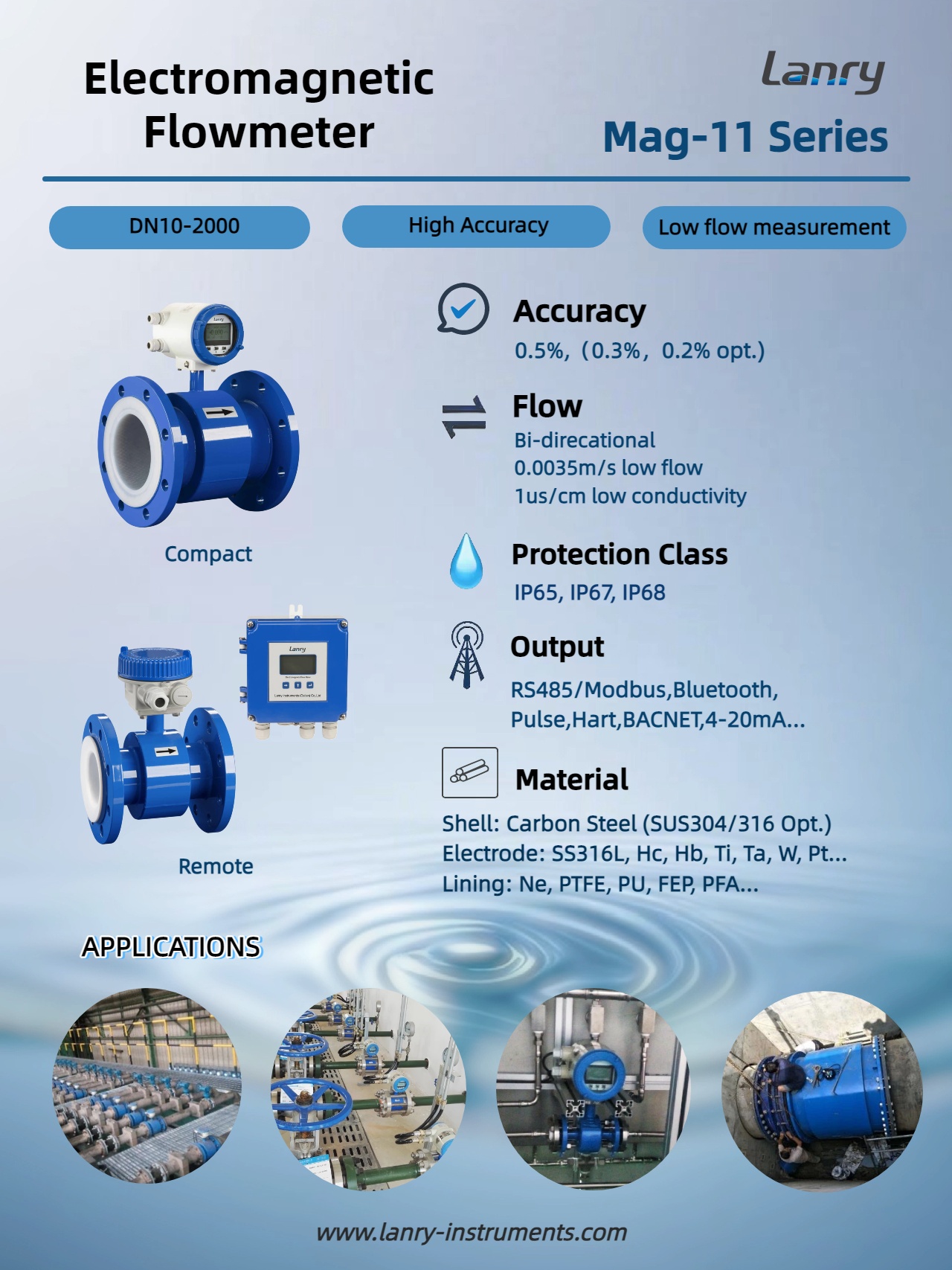
Lanry electromagnetic flowmeters are supplied in two mainstream structures: integrated and remote split styles. For the integrated version, the display transmitter is mounted directly onto the sensor body. It features a compact layout and simple installation, ideal for pump rooms, production workshops and accessible pipe chambers where local on-site reading is required. The split design separates the sensor and converter with dedicated signal cables. This variant suits difficult installation environments, such as underground pipe manholes, high-humidity areas or buried pipelines, where the sensor needs to be placed on the pipe while the display converter is mounted inside control cabinets for convenient viewing and operation. A wide selection of liner and electrode materials supports adaptation to different fluid characteristics. Rubber liners are suitable for potable water and general wastewater, while PTFE and PFA liners are selected for corrosive acidic and alkaline media. Material options such as 316L stainless steel, Hastelloy and tantalum electrodes guarantee long service life under harsh working conditions.
This series of flowmeters covers a broad range of industries. Municipal water supply networks adopt them to balance water distribution and support water loss control. Wastewater treatment facilities use magmeters to monitor inlet, outlet and sludge flow for process adjustment and environmental compliance reporting. Outside the water sector, they are widely applied in chemical production, papermaking, metallurgy, thermal power and food and beverage manufacturing. Measurement performance is barely disturbed by fluctuations in fluid temperature, pressure and viscosity, maintaining reliable accuracy over a wide turndown range. Available output options include 4-20mA, pulse signal, Modbus-RTU and HART communication, allowing smooth connection with PLC, SCADA and remote IoT systems for unified data gathering and automated logging.
Certification is critical for bidding and supplier qualification in global projects. Lanry electromagnetic flowmeters hold CE and ISO 9001:2015 certificates to meet international quality requirements and support pre-qualification for overseas tender projects. Flexible flange options are prepared to match regional standards. EN 1092 PN16 flanges are available to fit the common specifications widely used across the Middle East, Europe and Africa.
For modern industrial and water operators, trustworthy flow data is the foundation of resource optimisation, accurate billing and compliant discharge records. Electromagnetic flowmeters solve many common headaches of traditional flow instruments: lower maintenance frequency, extended service life and stable readings even for wastewater and fluids carrying solid particles. As global water infrastructure and industrial process projects keep growing, this mature metering solution remains a preferred option for pipeline flow measurement. It helps customers translate fluid flow data into practical operational decisions, supporting safer, more efficient and sustainable plant and network management.
Post time: Oct-29-2026