

Transit-Time vs. Doppler Ultrasonic Flow Meters: Which Is the Right Choice?
Compare working principles, applicable media and installation requirements to pick the suitable ultrasonic flow meter for your industrial measurement.
Transit-time ultrasonic flow meters and Doppler ultrasonic flow meters serve different working conditions. Transit-time types suit clean conductive-free liquids with few bubbles or particles, while Doppler versions work for liquids containing suspended solids or air bubbles. You can view our full series on Lanry product page to select the proper model.
1. How Do You Choose Between Transit-Time and Doppler Ultrasonic Flow Meters?
Ultrasonic flow meters are widely used for non-invasive flow measurement in water treatment, industrial processes, HVAC systems, and other applications. However, not all ultrasonic flow meters work the same way.
Two common technologies are transit-time ultrasonic flow meters and Doppler ultrasonic flow meters. Although both use ultrasonic signals to measure flow, they differ in their operating principles and liquid requirements.
Choosing the right technology depends mainly on the liquid's cleanliness, the presence of suspended particles or air bubbles, and the measurement conditions. This guide explains their differences and helps you select the right flow meter for your application.
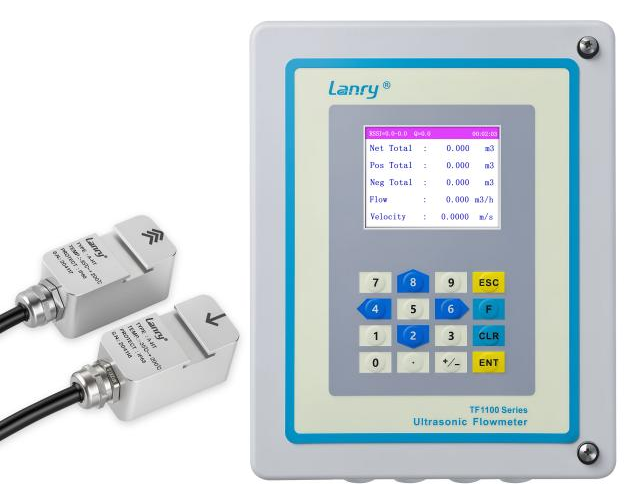
2. How Do Transit-Time and Doppler Ultrasonic Flow Meters Work?
Doppler Ultrasonic Flow Meter
A Doppler ultrasonic flow meter transmits ultrasonic signals into the flowing liquid and measures the frequency shift of signals reflected by suspended particles, solid impurities, or gas bubbles.
The frequency shift is related to the velocity of these reflectors, allowing the instrument to calculate flow velocity and volumetric flow rate.
Doppler technology is particularly suitable for liquids containing sufficient suspended solids or gas bubbles to produce a reliable reflected signal.

Transit-Time Ultrasonic Flow Meter
A transit-time ultrasonic flow meter measures the difference in the time required for ultrasonic signals to travel upstream and downstream through a liquid.
When the liquid flows, the downstream signal travels faster relative to the liquid, while the upstream signal travels slower. The difference in transit time is used to calculate flow velocity and volumetric flow rate.
This technology generally works best with clean liquids or liquids containing relatively few suspended solids or gas bubbles.

3. What Are the Main Differences Between Transit-Time and Doppler Flow Meters?
Although both technologies can offer non-invasive measurement, their performance depends on different liquid conditions.
Neither technology is universally better. The appropriate choice depends on the actual liquid and the installation conditions.
4. When Should You Choose a Transit-Time Ultrasonic Flow Meter?
A transit-time ultrasonic flow meter is generally the better choice when the liquid is clean or contains relatively low concentrations of suspended material. Consider this technology for the following applications:
Water supply networks, drinking water systems, and treated water pipelines.
Chilled water and hot water circulation.
Clean cooling water and other compatible process liquids.
Compatible liquids with suitable ultrasonic transmission characteristics.
Flow measurement in heating and cooling systems, including compatible thermal energy measurement configurations.
Transit-time meters are especially useful when the liquid provides a clear ultrasonic transmission path. However, excessive suspended solids, entrained gas, heavy scale, or poor acoustic transmission can weaken the signal and affect measurement performance.


5. When Should You Choose a Doppler Ultrasonic Flow Meter?
A Doppler ultrasonic flow meter is often a better option when the liquid contains suspended particles, solid impurities, or gas bubbles that can reflect ultrasonic signals. Typical applications include:
Measuring suitable wastewater streams containing suspended solids.
Monitoring compatible sludge and slurry flows.
Measuring liquids containing sufficient suspended particles.
Monitoring suitable slurry pipelines.
Measuring liquids with adequate suspended material or bubbles.


The key requirement is that the liquid must contain enough suitable reflectors to generate a reliable Doppler signal. If the liquid is too clean, the instrument may not receive sufficient reflected energy. Conversely, very high solids concentrations or strong signal attenuation can also affect performance. Actual suitability should be verified under the expected operating conditions.
6. How Do Liquid Conditions Affect Your Choice?
The selection of ultrasonic flow meters should comprehensively consider liquid properties, pipeline status and project measurement requirements. The core evaluation items are listed below:
Liquid cleanliness
Transit-time ultrasonic flow meters are preferred for clean water and relatively clear liquids. Doppler ultrasonic flow meters suit wastewater, sludge and media with suspended particles.
Air bubbles in liquid
A small amount of entrained air will interfere with transit-time measurement. Properly concentrated bubbles can serve as signal reflectors for Doppler flow meters.
Pipeline condition
Pipe material, wall thickness, lining, corrosion and scaling affect ultrasonic signal transmission. These parameters must be confirmed before choosing clamp-on type flow meters.
Pipe filling status
Both measurement technologies require suitable full-pipe conditions for stable volumetric flow reading. Partially filled pipes need dedicated alternative solutions.
7. How Can You Select the Right Flow Meter for Your Application?
Use the following guide as a starting point for selecting a suitable technology.
FAQ
Q1: What is the main difference between transit-time and Doppler ultrasonic flow meters?
Transit-time meters rely on ultrasonic time difference; Doppler meters work based on frequency shift from particles or bubbles in liquid.
Q2: Can a Doppler flow meter measure clean water?
Normally not recommended. Clean water lacks enough particles or bubbles for stable reflection. Transit-time is a better option.
Q3: Can a transit-time flow meter measure wastewater?
Yes if ultrasonic signals can pass through. Heavy solids or bubbles will weaken signals, then Doppler may be more proper.
Q4: Which technology fits slurry measurement?
Doppler is preferred for slurry with adequate suspended particles. High concentration slurry may cause signal attenuation and needs assessment.
Q5: Which type delivers higher accuracy?
It depends. Accuracy is affected by model, medium, pipe condition, installation and flow range. Check datasheet specs for your case.
Q6: How to select a suitable ultrasonic flow meter?
Confirm liquid type, solids/bubbles, pipe size, material, temperature and full-pipe condition. Choose transit-time for clean liquid and Doppler for particle-rich liquid. Consult our team if unsure.
Tell us your liquid application — we'll size the meter
Share your pipe size, flow range, medium condition and communication requirements. The Lanry team will select suitable transit-time or Doppler ultrasonic flowmeter for you.
Hello, I'm Michael Yang, Sales Engineer at Lanry Instruments. With over 8 years of hands-on experience in the flow-measurement industry, I draw on deep technical expertise to deliver targeted sales technical advice and optimized product configurations to maximize measurement performance for your industrial customers. Feel free to contact my WhatsApp.
Post time: Oct-22-2026