

Key Highlights of the
LRD Series 80GHz Radar Level Meter
01. Non-Contact Measurement
Unaffected by medium and process conditions, easy setup and maintenance-free.
02. Large range, samll blind area
03. Small antenna size and beam angle
04. Strong focusing ability
05. High Accuracy
06. Short Signal Wavelength
1.LRD 80GHz Series Radar Level Meter— Product Portfolio Summary
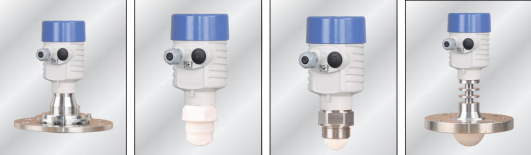
The LRD900 series consists of four tailored 80GHz FMCW radar level meter models, covering liquid, corrosive, sanitary, high-temperature, high-pressure and heavy dust/solid measurement scenarios for full industrial coverage:
A LRD901: Thread PTFE antenna type, suitable for conventional low-temperature and low-pressure corrosive liquid measurement with a 30m range.
B LRD902: Stainless steel composite thread type, adaptable to medium-high temperature and pressure liquids, supporting 30m and 120m measuring ranges.
C LRD903: Flange anti-corrosion type, designed for highly corrosive and sanitary media under steam conditions with ±2mm high precision.
D LRD904: High-performance flange type, specialized for 120m long-distance measurement of powder, particles and heavy-dust solid materials.
2. What is the working principle of the LRD901 Series 80GHz Radar Level Meter?
The 80G radar level meter uses frequency modulated continuous wave (FMCW) technology. The radar level meter transmits a high-frequency continuous frequency-modulated radar signal through its antenna. The transmitted signal is reflected by
the medium and received by the antenna as echoes with different frequencies. The frequency change is proportional to the
distance and converted to the material level height.
3. What Are the Key Features of the WM9100 Series Ultrasonic Water Meter?

4. What working environmental conditions can the WM9100 series ultrasonic water meter adapt to?
For ambient environment, its operating ambient temperature ranges from ‑40 ℃ to +70 ℃, relative humidity up to 100%RH. The protection class reaches IP68, so it can work for a long‑time under water, suitable for buried installation in water wells and wet manhole environments. Max working pressure is 1.6 MPa for DN15‑DN150; for DN200‑DN300 large‑size meters, the maximum working pressure reduces to 1.0 MPa. Temperature class is T30 as standard, T50 is optional for residential models. In terms of environmental compatibility, it meets climatic & mechanical environment Class O and E2 electromagnetic compatibility requirements, which enables stable operation under complex outdoor interference conditions. Please note that the meter complies with drinking‑water sanitary standards for potable water measurement, it is intended for clean drinking‑water, not for heavily polluted sewage.
5.Radar Level Meter VS Ultrasonic Level Mete
Both radar and ultrasonic level meters are mainstream non-contact level measuring devices, but they have essential differences in working principle, environmental adaptability and applicable scenarios:
A Working medium difference: Radar meters adopt electromagnetic microwaves, which can transmit without air medium; ultrasonic meters rely on air-conducted sound waves, and vacuum or dense steam will cause measurement failure
B Environmental resistance difference: Radar meters can resist high temperature, high pressure, foam and heavy dust interference; ultrasonic meters are easily affected by temperature changes, steam, foam and dust, resulting in data drift or failure.
C Measurement accuracy difference: Radar level measurement has higher precision and more stable data; ultrasonic accuracy is limited by on-site air environment, with relatively larger error in complex conditions.
D Applicable scenarios difference: Ultrasonic meters are suitable for conventional, stable and low-interference scenarios such as ordinary water tanks and sewage pools; radar meters are dedicated for harsh industrial scenes such as chemical reaction kettles, oil storage tanks and high-temperature vessels.
E Cost difference: Ultrasonic level meters are cost-effective for conventional monitoring; radar meters have higher cost but stronger comprehensive performance and longer service life.
6. Why Radar Level Sensors Outperform Traditional Level Measurement Solutions?
80 GHz Radar Level Meters outperform traditional level measurement solutions in multiple critical aspects. Unlike ultrasonic meters that rely on sound waves traveling through air, radar uses microwave signals unaffected by temperature shifts, steam, foam, condensation or heavy dust, delivering consistent readings in harsh industrial environments.
Equipped with compact narrow‑beam antennas, these sensors offer high accuracy of ±2 mm and a measuring range up to 120 meters, suitable for liquids, corrosive media, sanitary fluids as well as powders and granular solids. Requiring no tank filling or emptying for calibration, they feature easy commissioning and virtually maintenance‑free non‑contact measurement. Supported by explosion‑proof certifications, IP65/IP67 protection and dual HART / Modbus outputs, they provide reliable long‑term performance for complex process conditions.
7. The Application of LRD Series 80GHz Radar Level Meter

FAQ About the LRD Series 80GHz Radar Level Meter
Q1:What are the core advantages of 80GHz radar level meters?
Q2:What media can the LRD900 series measure?
Q3. Is the Radar Level Meter difficult to install and debug?
No. It supports simple on-site calibration without filling or emptying the tank. It is basically maintenance-free and supports long-term unattended operation.
Q4:What signal outputs and certifications does it support?
Q5:What should be avoided during radar level meter installation?
Keep the sensor away from tank walls, internal baffles, agitators and incoming material flow. Avoid installing within the measuring blind zone; false‑echo learning is required if fixed obstacles exist inside the tank.

Graduating with a Bachelor’s in Business English, as a sales engineer of Lanry Instruments more than 5 years.
Having participated in multiple overseas exhibitions,possess in-depth product knowledge of our complete instrument lineup
and strong capabilities for international client engagement.Should you have any project demands for instruments, pls feel free to contact me.
Post time: Sep-03-2026