

Electromagnetic flow meters have become one of the most reliable and widely adopted flow measurement devices for conductive liquid solutions across industrial, chemical, environmental, and water treatment industries. Unlike mechanical or ultrasonic meters that rely on fluid velocity differences or physical movement components, electromagnetic flow meters operate based on Faraday’s law of electromagnetic induction. This unique working principle enables them to provide stable, high-precision volumetric flow measurement for various homogeneous and mixed liquid solutions, making them the preferred solution for process control, batch dosing, chemical delivery, and industrial fluid monitoring.
One of the greatest strengths of electromagnetic flow meters is their excellent adaptability to conductive liquid solutions. They can accurately measure a wide range of solution media, including industrial wastewater, chemical solvent mixtures, acid and alkali dilute solutions, saltwater, brine, pulp mixtures, and various process water liquids. The only measurement requirement is that the medium possesses a certain level of electrical conductivity, which covers nearly all common aqueous solutions used in industrial production. This extensive medium compatibility allows electromagnetic meters to replace multiple types of traditional flow equipment and simplifies the overall fluid measurement system for production lines.
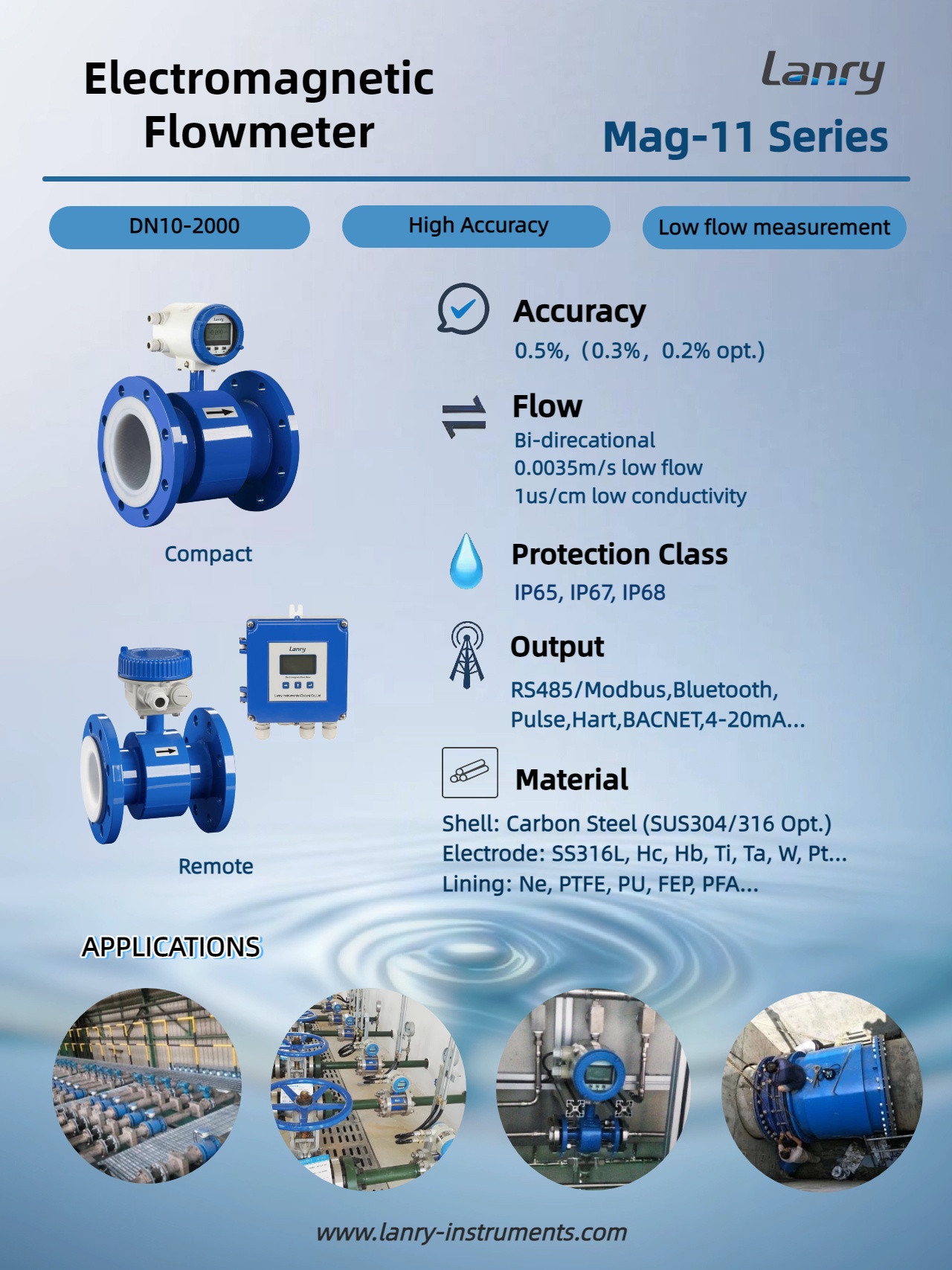
Electromagnetic flow meters deliver outstanding accuracy and stability during continuous solution measurement. With a standard measurement accuracy of ±0.5% or ±0.2% for high-grade versions, they maintain consistent precision regardless of changes in liquid temperature, density, viscosity, or pressure. Many chemical production processes involve variable solution concentrations and fluctuating working conditions, which often cause severe data drift in turbine or vortex meters. In contrast, electromagnetic sensors have no mechanical moving parts and do not depend on fluid kinetic energy, ensuring stable linear output even when solution properties slightly change during production operations.
The non-intrusive internal structure further enhances their reliability in solution measurement. The inner tube of an electromagnetic flow meter is fully lined with high-performance materials such as PTFE, rubber, or polyurethane. These lining materials provide excellent corrosion resistance and wear resistance, effectively protecting the meter body from damage caused by acidic, alkaline, saline, or chemically corrosive solutions. Whether measuring low-concentration chemical solutions or moderately corrosive industrial wastewater, the meter avoids scaling, adhesion, chemical erosion, and mechanical abrasion, significantly extending service life and lowering maintenance frequency.
Another key advantage in solution measurement is the meter’s zero pressure loss and full-pipe measurement capability. Since there are no blocking components inside the pipeline, the fluid passes through smoothly without energy loss, making electromagnetic flow meters highly suitable for circulating pipelines, continuous chemical dosing systems, and long-distance solution transportation lines. They support bidirectional flow measurement, allowing accurate monitoring of both forward delivery and reverse backflow, which is essential for complex industrial solution circulation and pipeline safety management.
Modern electromagnetic flow meters are equipped with powerful intelligent functions that greatly improve solution measurement efficiency. Built-in temperature compensation, signal filtering algorithms, and anti-interference technology enable stable operation in complex industrial environments with electromagnetic noise, vibration, and unstable fluid states. Most models support high turn-down ratios from R250 to R500, ensuring accurate detection of both tiny micro-flow and full-load flow, which meets the precise dosing requirements of fine chemical solutions and pharmaceutical liquid mixing processes.
In terms of data transmission and remote management, electromagnetic flow meters support standard 4-20mA, RS485 Modbus, and various wireless telemetry options including GPRS, NB-IoT, and LoRaWAN. Real-time flow data, cumulative volume, and equipment status can be uploaded to cloud platforms, realizing unattended monitoring, automatic data recording, and remote fault diagnosis. This intelligent feature is particularly valuable for large-scale chemical parks, water treatment plants, and centralized solution distribution systems.
In summary, electromagnetic flow meters offer unparalleled advantages in solution measurement, including strong medium adaptability, high precision, corrosion resistance, zero pressure loss, and intelligent remote transmission. They have become indispensable core equipment for chemical processing, environmental protection wastewater treatment, pharmaceutical production, and industrial liquid transportation. As industrial automation and smart factory construction continue to advance, electromagnetic flow meters will remain the most reliable and cost-effective solution for conductive liquid flow measurement across global industrial sectors.
Post time: Jul-20-2026