

In chemical processing, environmental protection wastewater treatment, pharmaceutical manufacturing, and papermaking industries, the precise flow measurement of strong acid and strong alkali corrosive liquids has long been a core technical challenge. Conventional flow measuring devices, such as turbine and vortex flowmeters, are prone to corrosion, blockage, and data deviation when applied to highly corrosive media, leading to frequent maintenance, high replacement costs, and unstable industrial operation. As a high-precision and high-reliability measuring instrument, the electromagnetic flowmeter has become the preferred solution for flow detection of strong acid and alkali liquids, relying on its unique working principle and anti-corrosion structural design.
Electromagnetic flowmeters operate strictly based on Faraday’s law of electromagnetic induction. When a conductive liquid flows through the uniform magnetic field inside the measuring tube, the fluid cuts the magnetic induction lines and generates an induced voltage signal. The amplitude of this voltage is directly proportional to the average flow velocity of the liquid. After being collected and processed by the high-precision electrode and transmitter system, the real-time volumetric flow of the liquid is accurately calculated. A key advantage of this working principle is that there are no moving parts or throttling components inside the measuring tube, resulting in zero pressure loss and no obstruction to fluid flow. This structural feature fundamentally avoids mechanical wear and particle blockage, perfectly adapting to the long-term continuous measurement demand of corrosive chemical media.
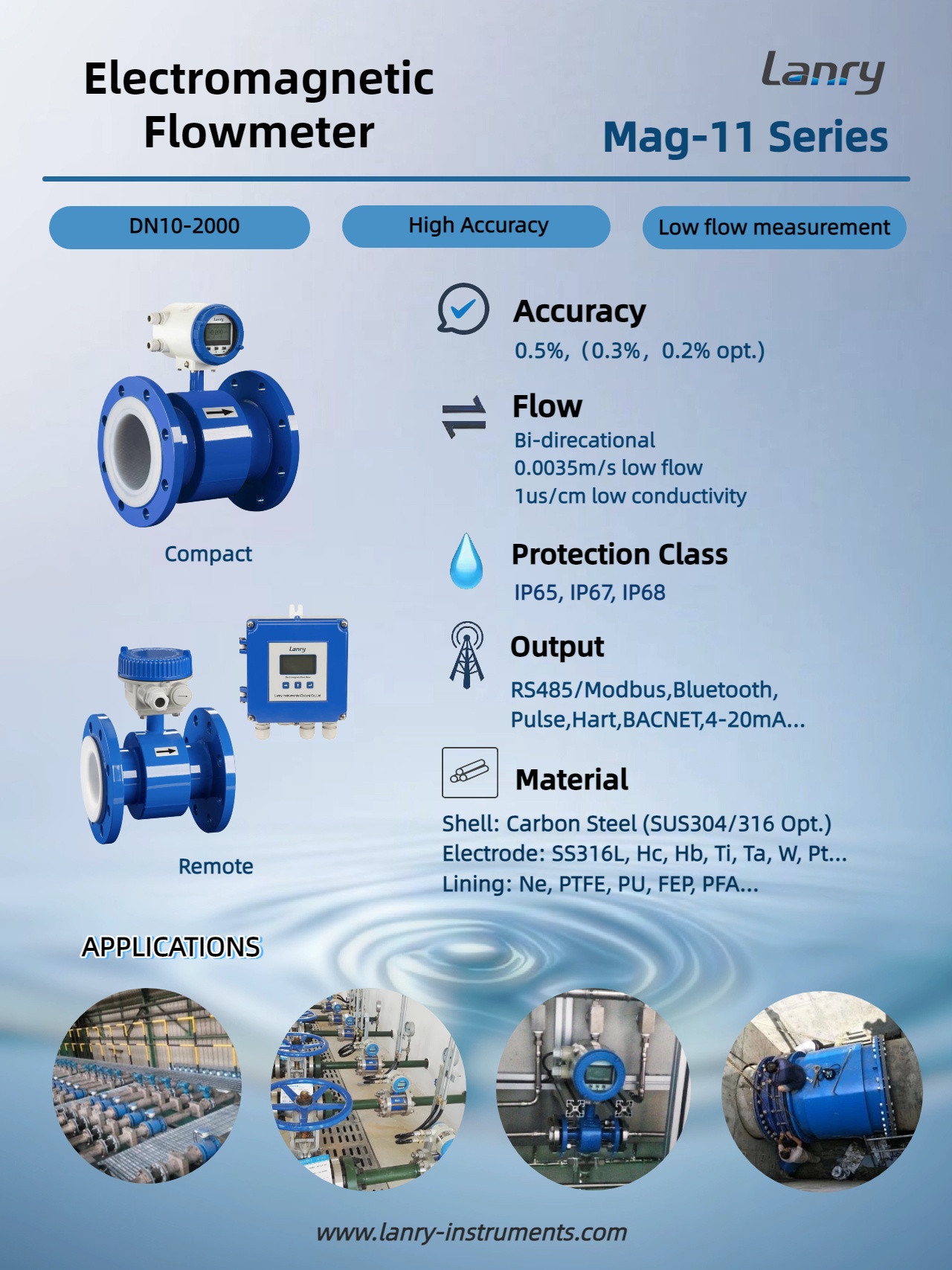
The excellent adaptability to strong acid and alkali liquids stems from professional anti-corrosion material matching, which is the core competitiveness of industrial-grade electromagnetic flowmeters. For highly acidic media such as hydrochloric acid, sulfuric acid, and nitric acid, tantalum electrodes and PTFE (polytetrafluoroethylene) lining are adopted. Tantalum metal exhibits ultra-strong corrosion resistance to most strong acids and oxidizing media, while PTFE lining resists erosion and chemical corrosion without reacting with acidic liquids. For strong alkali media including sodium hydroxide and potassium hydroxide solutions, Hastelloy C alloy electrodes and rubber or PFA lining are configured. These customized material combinations can effectively resist long-term chemical erosion, prevent electrode oxidation and lining aging, and ensure stable measurement performance in harsh corrosive environments.
Compared with other flow measuring instruments, electromagnetic flowmeters show irreplaceable advantages in corrosive medium measurement. Firstly, they are not affected by fluid viscosity, temperature, density, and solid particle content, enabling stable measurement of corrosive liquids with different concentrations and mixed liquid-solid two-phase fluids. Secondly, the measuring accuracy can reach ±0.5% or even ±0.2%, meeting the strict metering standards of chemical batching, industrial wastewater discharge monitoring, and pipeline transportation measurement. In addition, the integrated sealed structure and IP68 high protection grade allow the instrument to adapt to humid and corrosive workshop environments, with a service life of more than 10 years and extremely low later maintenance costs.
At present, anti-corrosion electromagnetic flowmeters have been widely applied in global industrial scenarios. In fine chemical plants, they accurately meter the transportation and batching of concentrated acid and alkali raw materials to ensure production formula accuracy. In environmental protection industries, they monitor the flow of acid-base wastewater in sewage treatment processes to help enterprises meet discharge standards. In papermaking and textile industries, they support the flow detection of corrosive bleaching and alkaline washing liquids. Moreover, the intelligent transmitter can output 4-20mA analog signals and digital communication signals, realizing seamless connection with industrial PLC and DCS systems to support automatic production and remote data monitoring.
In conclusion, with its scientific induction principle, professional anti-corrosion configuration, high measurement accuracy and stable operation performance, the electromagnetic flowmeter has completely solved the measurement pain points of strong acid and strong alkali corrosive liquids. It not only improves the precision and stability of industrial fluid metering but also reduces equipment operation and maintenance costs, becoming an indispensable core measuring device in modern chemical and environmental protection industries.
Post time: Aug-04-2026