

With the rapid development of industrial fluid measurement technology, flowmeters have become indispensable core equipment in petroleum, chemical, water supply, HVAC and energy management industries. Among various flow measurement devices, insertion ultrasonic flowmeters stand out due to their unique structural design, reliable performance and strong environmental adaptability. Different from traditional pipeline integrated flowmeters and external clamp-on ultrasonic flowmeters, insertion ultrasonic flowmeters balance measurement accuracy, installation convenience and operational stability, making them widely applied in complex industrial fluid monitoring scenarios.
The working principle of insertion ultrasonic flowmeters is based on the transit time difference method, which is mature and efficient for fluid velocity detection. The equipment is equipped with two plug-in ultrasonic transducers, which are inserted into the pipeline at a fixed angle and distance. The transducers can transmit and receive ultrasonic signals mutually. When ultrasonic pulses propagate downstream along the fluid flow direction, the sound transmission speed increases and the propagation time shortens; when propagating against the flow direction, the speed decreases and the time extends. The meter accurately captures the tiny time difference between the two propagation states, and calculates the real-time fluid flow velocity by combining pipeline diameter, sound emission angle and other preset parameters. Finally, the instantaneous and cumulative volumetric flow is obtained through the pipeline cross-sectional area calculation. This non-contact measurement principle avoids direct friction and interference between measuring components and the fluid, laying a foundation for stable and lossless operation.
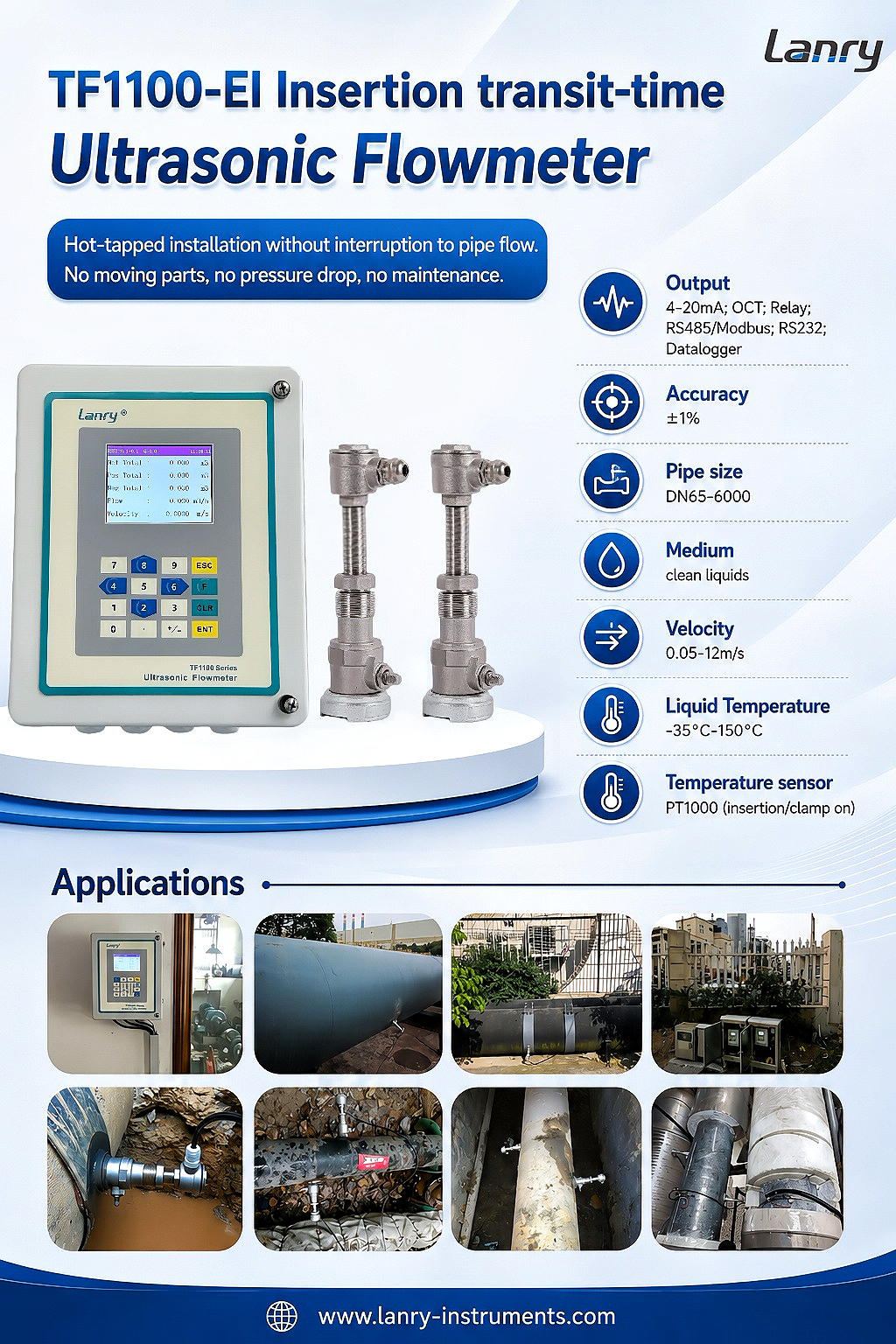
One of the most prominent features of insertion ultrasonic flowmeters is their excellent installation and maintenance advantages. Unlike in-line flowmeters that require pipeline cutting and system shutdown for installation, insertion models only need simple drilling and plug-in installation on the existing pipeline surface. The whole installation process does not affect the normal operation of the fluid delivery system, realizing non-stop construction and greatly improving construction efficiency. In daily maintenance, the transducer probe can be independently disassembled, cleaned and calibrated without dismantling the overall pipeline, which significantly reduces later maintenance costs and system downtime losses. This feature makes it particularly suitable for industrial pipelines that require continuous and uninterrupted operation.
Superior fluid adaptability is another core advantage of this type of flowmeter. It is not limited by the conductivity of measured media, and can accurately measure various conductive and non-conductive liquids, including tap water, industrial wastewater, crude oil, fuel oil and chemical reagents. Meanwhile, it has low requirements for fluid purity and can adapt to media containing a small amount of suspended particles. In terms of pipeline adaptability, it is compatible with metal and non-metal pipelines of different calibers, solving the measurement limitations of traditional flowmeters for large-diameter pipelines. In addition, the equipment has no internal flow-blocking components, resulting in zero pressure loss during measurement. This unobstructed flow structure effectively reduces pipeline transportation energy consumption, meeting the energy-saving and efficient operation requirements of modern industrial systems.
In terms of measurement performance, insertion ultrasonic flowmeters achieve a perfect balance between high accuracy and strong stability. With optimized signal processing algorithms, their measurement accuracy can reach ±0.1% of reading, supporting stable monitoring of low-speed and high-speed fluid flow. The built-in anti-interference module can effectively resist the influence of industrial electromagnetic interference, pipeline vibration and temperature changes, ensuring long-term consistent measurement data. Moreover, the equipment supports real-time data output, remote transmission and multi-data recording, which is convenient for industrial automatic control and data statistical analysis.
In conclusion, insertion ultrasonic flowmeters integrate convenient installation, wide adaptability, zero pressure loss and high measurement precision. They make up for the defects of traditional flow measurement equipment and have become ideal tools for industrial fluid flow monitoring. With the continuous upgrading of industrial intelligent monitoring systems, this type of flowmeter will have broader application prospects in industrial production, urban pipe network management and energy conservation supervision.
Post time: Aug-04-2026